
AI for Inbound Lead Response
Learn how AI is transforming inbound lead response workflows.
A private equity firm downloads a B2B software buyer guide at 9:12 p.m.
Two minutes later, the managing partner submits a demo request from his phone while moving between meetings in an airport lounge. He is not looking for a long nurture sequence. He is looking for momentum.
If nothing happens right away, the moment collapses.
Not because the lead was weak.
Not because the offer was wrong.
Not because the sales team is bad.
The real issue is that the business had no system for real-time engagement when intent was highest.
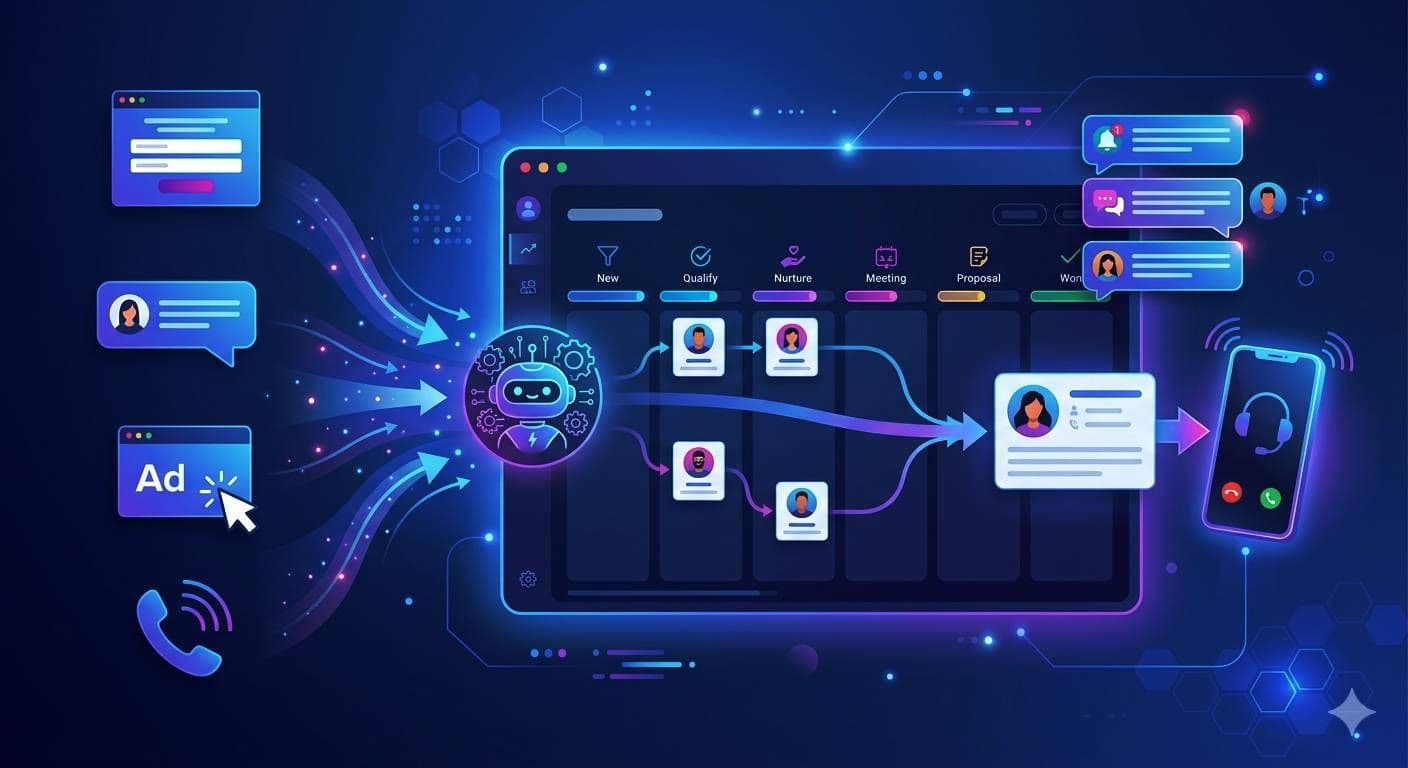
This is where AI for Inbound Lead Response changes the equation. Instead of letting a form submission sit in a queue until a rep becomes available, AI can engage the lead instantly, ask the first questions, route the conversation, and move the opportunity forward while the buyer is still mentally present.
That matters more than most teams realize.
Here is the contrarian truth: speed is not just about replying faster. Speed is about preserving buyer intent before it decays. If your process cannot engage in real time, your funnel is leaking at the exact moment marketing finally did its job.
The Real Problem Is Not Delay Alone. It Is Lack of Real-Time Engagement
A lot of companies think they have a lead response problem because reps are busy.
That is only partially true.
The deeper problem is that inbound demand now arrives in bursts, across channels, at unpredictable times. Website forms, paid ad leads, demo requests, landing pages, and chat handoffs all create micro-moments of buying intent. Those moments are short.
If your business cannot respond in the same moment, the lead does not experience continuity.
They experience silence.
That silence creates friction.
A form fill is a raised hand. But from the buyer's perspective, it is also a test. They are evaluating whether your company feels responsive, modern, and easy to buy from. When nothing happens after submission, the prospect does not just wait. They reassess.
This is one of the clearest explanations for
https://www.fusionsync.ai/posts/lead-response-time-5-minute-rule
It is not simply that time passes. It is that the business fails to convert interest into interaction while the buyer is still engaged.
How AI for Inbound Lead Response Compresses the Intent Gap
The most useful way to think about AI for Inbound Lead Response is not as a chatbot or an automation layer.
It is an intent compression system.
It shrinks the gap between signal and conversation.
A prospect submits a form.
The AI responds in seconds.
The lead gets a text, an email, or even an instant call.
The system asks qualification questions.
It captures buying context.
It offers scheduling.
It routes the opportunity with actual information attached.
That entire sequence can happen before a human rep even sees the notification.
This is important because the first few minutes after submission are not administrative. They are psychological.
The buyer is still thinking about:
- the problem they want solved
- the pages they just viewed
- the pricing questions they have
- the urgency behind the inquiry
If AI engages in that window, the business stays attached to the buyer's attention.
If AI does not engage, attention drifts.
And once attention drifts, the next response has to rebuild context from scratch.
Why This Issue Happens in Otherwise Good Sales Teams
Most teams do not fail because they do not care.
They fail because human availability does not match inbound timing.
That mismatch shows up in a few predictable ways.
First, lead arrival is uneven. High-intent requests often come in after hours, during lunch, during demos, or while reps are working existing pipeline.
Second, human response is batch-based. Reps clear notifications when they can. Managers review queues in blocks. Someone checks the CRM when a meeting ends.
Third, the handoff process itself slows the first interaction. Before a rep reaches out, the lead may need to be assigned, enriched, prioritized, or reviewed.
The result is that a buyer who was ready at 9:12 p.m. receives a first meaningful touch at 8:40 a.m. the next day.
That is not just slow. It is structurally disconnected from how buying intent works.
This is why many teams benefit from combining AI engagement with better routing logic. If you want a deeper look at the operational side, this guide on
http://fusionsync.ai/posts/automatic-lead-assignment
is a useful companion.
What Happens When the First Response Is Not Immediate and Interactive
When companies think about lead response, they often focus on speed as a metric.
But the real loss comes from what does not happen in the first few minutes.
No qualification happens.
No meeting gets offered.
No context gets captured.
No urgency gets surfaced.
No next step gets secured.
That creates four business problems.
1. Contactability Drops
The longer a lead waits, the harder they are to reach.
A prospect who would have replied to a text in 30 seconds may ignore an email six hours later. A buyer who would have answered an immediate callback may decline an unexpected call the next morning.
2. Sales Context Disappears
When a lead submits a request, there is usually a reason behind the timing. Maybe they just got budget approval. Maybe a campaign underperformed. Maybe they need a vendor before quarter-end.
That context is freshest right after conversion.
Without immediate engagement, the business loses access to the buyer's most honest and useful details.
3. Scheduling Momentum Vanishes
Appointment booking is easiest when intent is active.
Once the lead returns to their day, calendar friction increases. They need to think harder, compare more options, and re-enter decision mode later.
4. Marketing Efficiency Quietly Erodes
Paid campaigns, SEO content, landing pages, and brand trust all worked together to generate the lead.
If there is no real-time engagement layer after the conversion event, the business wastes the most expensive part of the funnel: acquired intent.
A useful adjacent read here is
http://fusionsync.ai/posts/automate-demo-booking
because booking speed is often where intent is either captured or lost.
Real-Time Engagement Changes Buyer Behavior Before It Changes Metrics
A lot of articles talk about response time in terms of conversion rate.
That matters, but there is something even more immediate.
Fast, AI-driven engagement changes how the buyer feels about the company.
An instant, relevant response signals operational maturity.
It tells the lead:
- this company is paying attention
- this company is easy to engage with
- this company can move at my pace
That perception matters in high-consideration sales.
In B2B especially, buyers often interpret responsiveness as a proxy for future service quality. If the pre-sales experience feels delayed and fragmented, they assume implementation, support, and communication may feel the same.
This is the sharper insight many teams miss:
Slow follow-up does not merely delay sales. It weakens confidence in the vendor before the first conversation even begins.
So when AI engages instantly, it is not just helping sales operations. It is shaping buyer trust in real time.
What an Effective AI Response Workflow Actually Looks Like
The best AI systems do not just send a generic autoresponder.
They create a live bridge between inquiry and action.
A strong inbound workflow usually looks like this:
- A lead submits a form or demo request.
- AI responds within seconds through the right channel.
- The system confirms the inquiry and references the context.
- AI asks 1 to 3 qualification questions.
- Based on answers, the lead is scored or routed.
- The system offers an instant booking option or places a callback.
- If the lead does not engage, follow-up begins automatically.
That sequence solves the actual problem: the dead space after form submission.
And that dead space is expensive.
If you want to compare channels, this article on
http://fusionsync.ai/posts/multi-channel-lead-response
helps explain why SMS, phone, and email often work better together than alone.
Why AI Works Better Than Manual Speed Improvements Alone
Companies often try to solve this by telling reps to respond faster.
That rarely works at scale.
Manual discipline helps, but it does not create constant availability. It does not answer leads at 11:07 p.m. It does not immediately qualify 14 paid ad submissions that arrive in a 20-minute burst. It does not consistently trigger the right channel sequence every time.
AI does.
That is the real advantage.
AI makes instant response repeatable.
Not heroic.
Not dependent on whoever is free.
Not vulnerable to weekends, meetings, or queue backlogs.
And once speed becomes systemized, the business can improve more than first-touch time. It can improve data capture, handoff quality, meeting rates, and follow-up consistency.
This is why AI is becoming central to modern inbound operations. It is not replacing human sales conversations. It is protecting the small window in which those conversations are easiest to start.
Practical Ways to Implement AI for Real-Time Inbound Engagement
If a company wants better outcomes from inbound leads, the goal should be simple: remove the silent gap after conversion.
A few practical moves make the biggest difference.
Respond in Seconds, Not Minutes
The first touch should happen almost immediately.
That can be an SMS, email, AI voice call, or a coordinated combination based on lead source and urgency.
Ask Only the Questions That Move the Deal Forward
Do not turn the first interaction into a long form after the form.
Use AI to gather the minimum useful context, such as company size, urgency, service need, or booking preference.
Trigger Booking While Intent Is High
The best time to offer a meeting is during the initial attention window.
If the lead is ready, let them act immediately.
Route With Context, Not Just Speed
A fast handoff is good.
A fast handoff with qualification notes is much better.
Automate Follow-Up if the Lead Does Not Respond Right Away
Real-time engagement should not end after one attempt.
AI should continue the sequence so that no interested lead slips back into silence.
The Bigger Takeaway
Most companies think inbound conversion problems begin before the form.
Often, they begin after it.
The weakness is not always lead volume, ad quality, or sales talent. It is the absence of an immediate engagement layer that keeps buyer intent alive long enough for the sales process to begin.
That is why this topic matters so much.
AI for Inbound Lead Response is not just a faster way to send messages. It is a way to hold onto the exact moment a buyer is ready to talk, ask the right questions, and take the next step.
In practical terms, that means more conversations start while interest is still fresh.
And when more conversations start in the right window, more pipeline gets created from the demand you already paid for.
Key Takeaways
- Inbound leads often go cold because there is no real-time engagement immediately after form submission.
- The biggest loss is not just delayed response. It is the disappearance of buyer attention, context, and scheduling momentum.
- AI compresses the gap between inquiry and conversation by responding in seconds.
- Effective AI workflows qualify, route, and book while intent is still active.
- Manual speed improvements help, but AI makes instant engagement consistent and scalable.
- AI for Inbound Lead Response works best when it removes silence, captures context, and creates immediate next steps.
FAQ
1. What is AI for inbound lead response?
AI for inbound lead response refers to systems that automatically engage new leads the moment they submit a form, request a demo, or take another inbound action. These systems can send messages, place calls, ask qualifying questions, route leads, and help book meetings in real time.
2. Why is real-time engagement better than just sending an auto-reply?
A basic auto-reply confirms receipt, but it does not move the conversation forward. Real-time AI engagement is interactive. It captures information, creates momentum, and helps secure the next step while the buyer is still paying attention.
3. Can AI replace human sales reps in inbound response?
Usually, no. The better use case is that AI handles the first seconds and minutes, when speed matters most. It qualifies, engages, and routes leads so human reps can step in with more context and better timing.
Next step
Let's Fix Your Lead Response in 30 Minutes
We'll walk through your current lead flow, identify where leads are slowing down or getting missed, and show you exactly what can be automated to increase speed, conversations, and bookings.
Where it works
View all use cases