
Automation
How AI Boosts Conversion Rates for Chandigarh Businesses

Updated
AI automation does more than respond quickly. Learn how automated qualification and follow-up improve conversion rates.
A Chandigarh service business can generate dozens of inquiries in a week and still struggle to turn them into booked calls or paying customers. The problem is rarely lead volume alone. More often, it is the gap between inquiry and action: a missed call, a delayed WhatsApp reply, an unqualified lead sitting in the inbox, or a follow-up that never happens because the team is busy. By the time someone responds, the prospect has already spoken to a competitor.
This is where AI automation changes the conversion equation. Instead of relying on manual follow-up and inconsistent team behavior, businesses can create a structured response system that qualifies leads quickly, routes them correctly, and keeps the pipeline moving until a decision is made.
In this article, we’ll break down how AI automation improves conversion rates for Chandigarh businesses through faster response times, consistent qualification, and automated follow-up. We’ll also look at practical workflows, implementation examples, and the systems that work best together inside a conversion-focused automation stack.
The Real Conversion Problem Businesses Face
For many Chandigarh businesses, the challenge is not generating interest. It is converting interest before it goes cold.
This shows up in several common ways:
- A lead fills out a website form and gets a reply hours later.
- A prospect calls after office hours and gets no answer.
- A team member speaks to the lead but forgets to log details in the CRM.
- Follow-up messages are sent inconsistently, depending on who is available.
- Sales teams spend time on low-intent inquiries instead of sales-ready prospects.
In sectors like real estate, education consulting, healthcare, home services, immigration consulting, and B2B services, these gaps directly affect revenue. A lead who is ready to buy today may not be ready tomorrow. If your process does not respond quickly and qualify accurately, your conversion rate drops even if lead volume stays the same.
That is why conversion optimization automation in Chandigarh is increasingly less about “automation for convenience” and more about operational control. Businesses need a system that captures interest, reacts instantly, and structures the next step.
Why Traditional Approaches Fail
1. Response time depends on human availability
If the owner, receptionist, or sales rep is in a meeting, driving, or handling another customer, the lead waits. In most industries, that wait reduces the chance of conversion.
2. Follow-up is inconsistent
Sales teams often start strong and then taper off. Leads that require three, four, or five touchpoints are frequently lost because the follow-up process is not systemized.
3. Qualification happens too late
Teams often call every lead the same way. That means high-intent prospects do not get fast-tracked, and low-fit prospects consume time that should go to stronger opportunities.
4. CRM data becomes unreliable
If call notes, tags, stages, or source fields are not updated consistently, the sales pipeline becomes difficult to trust. Poor data leads to poor decisions.
5. There is no single conversion workflow
A form fill, missed call, chat message, and referral may each be handled differently. Without a unified system, the business cannot measure which channels produce qualified opportunities.
This is why many businesses eventually look for an AI automation agency in Chandigarh to help standardize lead handling.
How the AI Automation System Works
Flow:
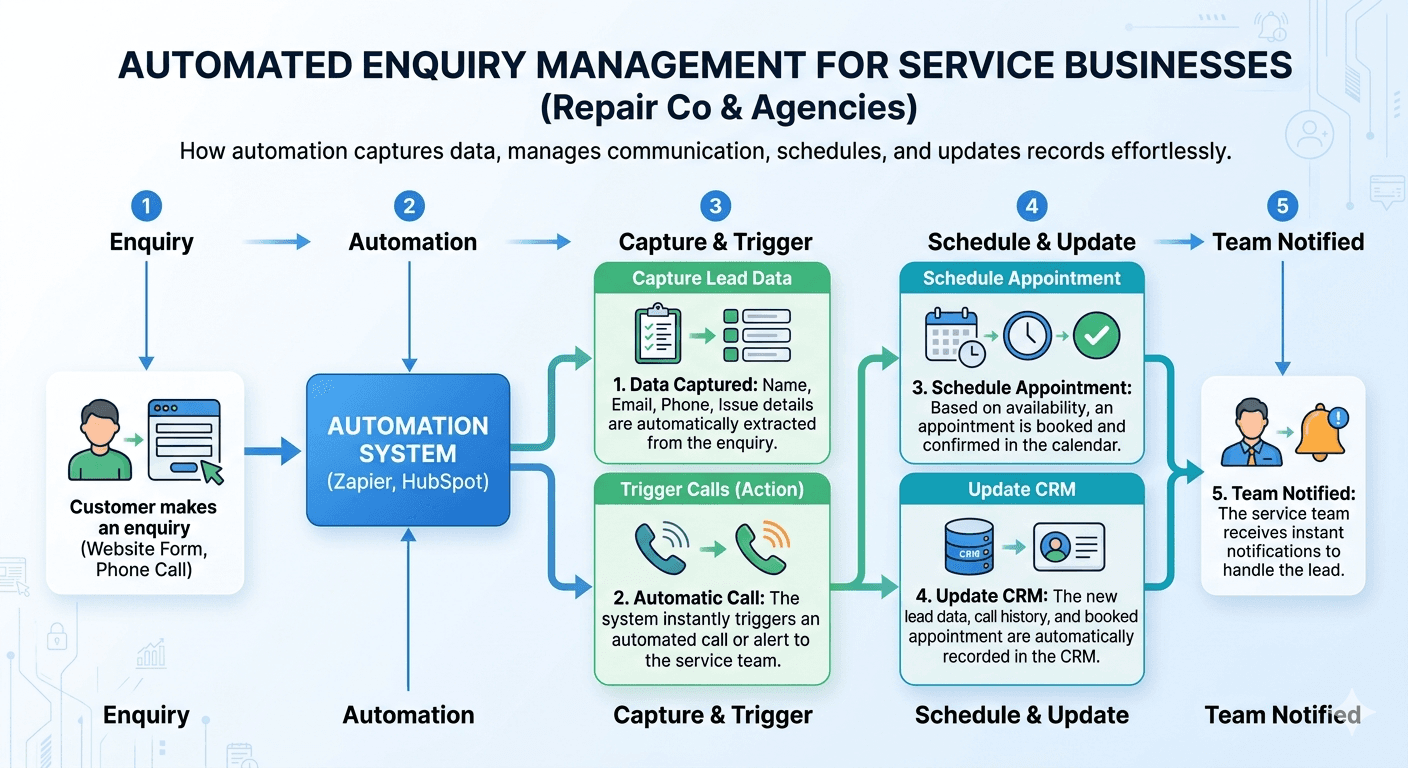
Lead form / missed call / WhatsApp inquiry → trigger → AI response → qualification → CRM update → booking or handoff → follow-up sequence
Step 1: Lead enters the system
- website forms
- Google Ads landing pages
- Facebook Lead Ads
- WhatsApp click-to-chat
- missed calls
- inbound phone calls
- chatbot conversations
Step 2: Automation triggers immediately
- AI voice call
- WhatsApp message
- SMS
- CRM task
Step 3: AI qualifies the lead
- service needed
- urgency
- budget
- location
- timing
- decision-maker
Step 4: CRM updates automatically
- source
- tags
- notes
- stage
- next action
Step 5: Routing
- hot → salesperson
- medium → booking
- low → nurture
Step 6: Follow-up continues
- reminders
- callbacks
- content
- booking prompts
Practical Implementation: Chandigarh Workflow
Example: Education consultant
Workflow
- Form or missed call
- Webhook trigger
- AI response
- Qualification questions
- Lead scoring
- CRM update
- Human routing
- Nurture if needed
Tools
- form builder
- CRM
- automation platform
- AI voice/chat
- calendar
- messaging
Benefits and Strategic Impact
Faster response
Better qualification
Consistent follow-up
Better data
Predictable pipeline
Higher conversions without more ad spend
Related Systems
- AI voice agents for real estate in Chandigarh
- speed-to-lead systems in Chandigarh
- AI lead qualification in Chandigarh
- AI CRM reactivation in Chandigarh
- AI SDR workflows for Chandigarh sales teams
- CRM automation for Chandigarh companies
- AI automation agency in Chandigarh
FAQs
How does AI automation improve conversion rates?
It improves conversion rates by responding faster, qualifying leads consistently, and ensuring follow-up happens on time.
Is AI automation only useful for large businesses?
No. Small and mid-sized businesses benefit the most.
What types of businesses see the biggest impact?
Service businesses, consultants, clinics, real estate teams, and B2B agencies.
Does automation replace the sales team?
No. It supports them.
What is the most important part of the system?
Speed-to-lead + qualification.
Conclusion
AI automation improves conversion rates by fixing the operational problems that cause leads to slip away: slow response times, inconsistent follow-up, and poor qualification.
For Chandigarh businesses, that means:
- more efficient pipelines
- better use of sales time
- clearer visibility into revenue
The most effective systems are connected workflows that capture leads, respond instantly, qualify intelligently, update the CRM, and keep the conversation moving until a booking or sale happens.
AI-native business systems
Bring a niche, or bring a workflow.
If you run the business, we build the system around it. If you sell into a niche, we build the system behind your offer.
PolarBuild case study →You sell the niche. We build the system.
We never compete for your end clients. One partnership conversation. You fulfil the same system across the accounts in your niche.
Free POC before dedicated software
A three-day sales demo of the system for your vertical before any large software investment. Implementation starts only when someone in that niche pays.
Replicate the niche, not a one-off build
UK dental becomes US dental with a new local partner and new integration targets. Same system thesis, new market.