
Speed To Lead
Why Fast Lead Response Matters for Chandigarh Businesses

Updated
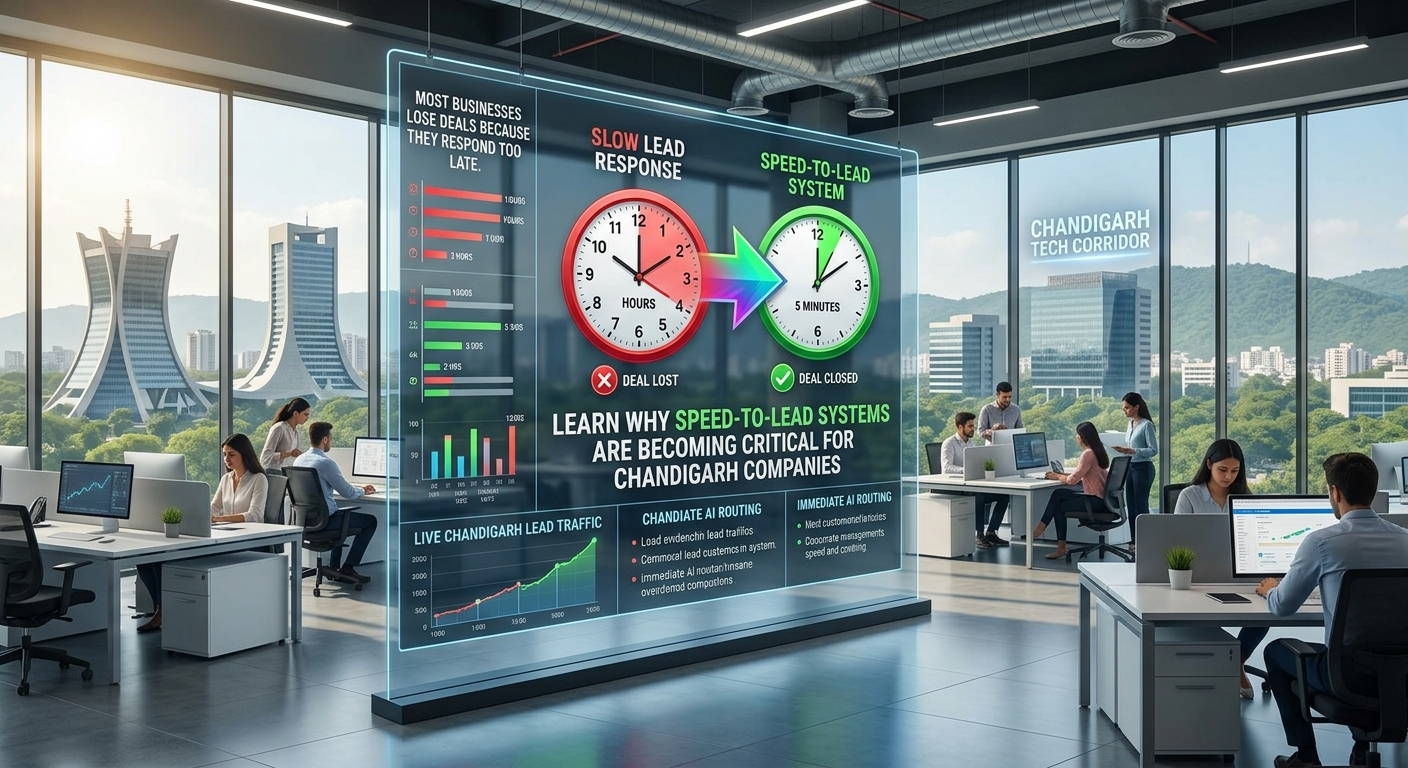
Most businesses lose deals because they respond too late. Learn why speed-to-lead systems are becoming critical for Chandigarh companies.
A prospect fills out a contact form on your website at 10:14 AM. They’re comparing three providers, they’ve got budget approval, and they’re ready to talk. But your sales team sees the lead after lunch, calls back in the evening, and the prospect has already booked with someone else. That gap between inquiry and first response is where a lot of revenue disappears.
For many Chandigarh businesses, this isn’t a rare mistake, it’s a daily operational issue. Leads come in from website forms, WhatsApp clicks, social ads, missed calls, and landing pages. The problem is not always lead quality. Often, it’s the delay in response, the lack of follow-up discipline, or the absence of a system that reacts instantly. In a market where customers compare quickly and choose whoever replies first, speed matters as much as offer quality.
That is why speed-to-lead automation Chandigarh is becoming a serious competitive advantage. In this article, we’ll break down why late replies cost deals, how traditional processes fail, how AI automation fixes the bottleneck, and how businesses in real estate, education consulting, and home services can build a faster response system.
The Real Problem Businesses Face
Most businesses believe they are losing leads because of pricing, competition, or weak salespeople. Sometimes that’s true. But in many cases, the real issue is much simpler: the lead was not contacted fast enough.
A lead inquiry is not a passive event. It’s a signal of active intent. If someone submits a form or calls your business, they are typically in the middle of a decision. That decision window is short.
In Chandigarh, this is especially relevant for service businesses that depend on quick comparison shopping:
- Real estate buyers enquire with multiple agents in one session
- Students contact several education consultants at the same time
- Home service customers call whoever answers first
- B2B buyers expect a callback before they lose momentum
The operational issue is not just speed. It’s consistency. One lead gets a fast callback because the sales rep was free. Another gets delayed because the team was busy. Another is missed entirely because the call happened after office hours.
Without a system, response quality depends on human availability. That creates inconsistency, and inconsistency creates lost revenue.
Why Traditional Approaches Fail
Manual lead handling sounds simple on paper:
- Lead comes in
- Sales rep sees notification
- Rep calls back
- If the customer answers, the lead is qualified
- CRM gets updated later
The problem is that this chain breaks easily.
1. Delayed responses reduce connection rates
The longer a business waits, the less likely the prospect is to answer or stay interested. By the time the callback happens, they may already be in another conversation, at work, or no longer in buying mode.
2. Manual follow-up is inconsistent
Human teams do their best, but they are affected by workload, breaks, missed notifications, and after-hours enquiries. A lead sent at 9:30 PM or on Sunday may wait until the next business day, which is often too late.
3. CRM updates happen after the fact
In manual systems, the CRM is often updated only after the call. That means managers cannot see real-time activity, and follow-up sequences may not trigger properly.
4. Qualification takes too long
Even when someone answers, the rep still has to ask basic questions, record details, check budget, decide fit, and move the prospect forward. If this process is inconsistent, the team wastes time on unqualified leads while hot leads cool down.
5. Missed calls are a hidden leakage point
A missed call is often a lead with strong intent. If nobody calls back immediately, that opportunity may never return. This is why many businesses now use lead response automation and missed-call workflows to capture intent before it disappears.
For companies that want better response discipline, systems like AI lead response automation in Chandigarh are designed specifically to reduce this gap between inquiry and action.
Why Speed-to-Lead Matters So Much
Speed-to-lead is not just a sales metric. It’s a behavioral advantage.
When a prospect reaches out, they are at the top of their attention curve. At that exact moment:
- they remember the problem clearly
- they are open to a conversation
- they have not yet built commitment elsewhere
- they are likely comparing options
If you respond fast, you catch the buyer while intent is still active.
If you respond late, the lead cools down.
That’s why businesses often see a drop in conversion when callback times stretch from minutes to hours. The lead is still valid, but the urgency is gone.
This is especially true for industries where decisions are time-sensitive:
- property visits
- course admissions
- emergency repairs
- medical appointments
- service bookings
For these businesses, lead response automation is not a convenience feature. It is a conversion system.
How the AI Automation System Works
A fast lead response system does not rely on people watching inboxes all day. It uses event-driven automation.
Here is a practical workflow:
1. Lead enters from a source
This could be:
- website form
- landing page
- Facebook lead form
- Google ad form
- missed call
- WhatsApp click
- call tracking system
2. Trigger fires instantly
The moment the lead is captured, a webhook or integration sends the data into the automation stack.
3. AI voice or message responds immediately
An AI voice agent or automated message contacts the lead within seconds. The purpose is to acknowledge, qualify, and route the lead while the intent is still fresh.
4. Qualification questions are asked
The automation can ask basic questions such as:
- What service do you need?
- When do you want to start?
- What is your budget?
- What location are you looking at?
- Do you want a callback or a meeting link?
5. Lead gets scored or tagged
Based on answers, the lead is categorized:
- hot lead
- warm lead
- not a fit
- needs manual follow-up
- appointment booked
6. CRM is updated automatically
The system pushes the result into the CRM with tags, notes, timestamps, and next steps.
7. Sales team is notified only when needed
Instead of wasting time on every lead manually, the team gets alerted when the lead is qualified or ready to move forward.
This is where tools like CRM automation for Chandigarh companies become important. A fast response system is only useful if the CRM reflects the status instantly and follow-up workflows are triggered correctly.
Practical Implementation: A Mini Playbook
Let’s look at what this might look like for a Chandigarh service business.
Example: Education consultancy
A student submits an admission inquiry form on the website at 8:40 PM.
Workflow design
- Form submission triggers automation immediately
- AI voice agent calls within 30–60 seconds
- If the student answers, the system asks:
- Which course are you considering?
- Which country or city are you targeting?
- What intake are you planning for?
- Have you taken a language test?
- The system logs the answers into the CRM
- If the lead is qualified, the system books a counseling slot
- If the lead is not ready, it enters a follow-up sequence
Why this works
Education leads often come in after office hours. Manual callback the next morning is too slow. A system that responds instantly captures more inquiries before they go cold.
A dedicated workflow like AI automation for education consultants in Chandigarh is a strong fit here because it combines lead qualification, instant response, and appointment booking.
Example: Home services business
A homeowner requests a plumbing or AC repair callback from a landing page.
Workflow design
- The inquiry triggers an instant call or SMS
- AI asks for location, issue type, and urgency
- If it is an urgent job, the lead is escalated to the nearest technician
- If it is a routine request, the lead is scheduled for a callback window
- CRM updates the job details automatically
This reduces the chance that an urgent lead waits in a queue while competitors respond first. For this kind of business, AI automation for home services in Chandigarh can directly improve booking speed and dispatch efficiency.
Example: Real estate enquiry
A buyer fills out a property form.
Workflow design
- Instant acknowledgment via AI voice or message
- Qualification questions about budget, preferred area, and property type
- Lead scored based on buying urgency
- CRM updated
- Sales rep receives only high-priority leads
- If the buyer wants property options, the system can route them to a listing follow-up sequence
Real estate teams often benefit from combining response automation with AI voice agents for real estate in Chandigarh, because voice outreach can qualify interest much faster than manual calling alone.
What the Best Lead Response Automation Stack Looks Like
A practical stack does not need to be overly complex. It needs to be reliable.
Core components
- Lead source: forms, ads, calls, WhatsApp
- Trigger system: webhook or native integration
- AI layer: voice agent, chat assistant, or SMS automation
- CRM: for lead storage and pipeline management
- Calendar: for booking appointments
- Notification layer: Slack, email, SMS, or internal alerts
Recommended logic
- Respond within seconds, not minutes
- Capture the lead source automatically
- Ask only the minimum qualification questions needed
- Route hot leads instantly
- Push all data into CRM
- Start follow-up sequences for non-responsive leads
Important design principle
Automation should reduce friction, not create it. If the process is too long or robotic, the prospect may drop off. The goal is to move the lead to the next stage with the least resistance.
This is where a strong AI automation strategy from an AI automation agency in Chandigarh can help businesses design workflows that actually fit how their customers behave.
Strategic Benefits of Speed-to-Lead Automation
The value of speed-to-lead automation is not just “faster replies.” The business impact is broader.
1. Higher conversion opportunity
The fastest responder often has the best chance of starting the conversation before competitors do. This does not guarantee a sale, but it improves the odds significantly.
2. Better lead experience
Customers feel acknowledged immediately. Even if they are not ready to buy now, they know the business is responsive and organized.
3. Improved sales team efficiency
Salespeople should spend time on qualified opportunities, not on sorting inbox noise or chasing unresponsive leads.
4. Cleaner CRM data
Automated logging means every lead has a timestamp, source, status, and next step. That improves visibility for managers and owners.
5. Better after-hours coverage
Many leads arrive outside office hours. An automated response layer ensures these leads are still handled immediately instead of waiting until the next business day.
6. More predictable pipeline
When lead handling is standardized, owners can forecast performance more accurately. They can see whether leads are being nurtured, booked, or lost.
Related Systems That Strengthen the Workflow
Speed-to-lead works best when it is part of a broader automation system rather than a standalone trick.
For example:
- If your business handles many phone enquiries, AI missed call automation in Chandigarh helps capture intent from callers who do not connect the first time.
- If your sales team needs structured outreach after qualification, AI SDR workflows for Chandigarh sales teams can take over follow-up and appointment setting.
- If your pipeline is messy, AI lead qualification in Chandigarh helps ensure only the right leads reach human reps.
These systems are especially useful when connected through the broader automation architecture offered by an AI agency in Chandigarh, because isolated tools often fail when CRM, calling, and follow-up are not aligned.
Another useful pairing is automation plus reactivation. Many businesses focus only on new leads, but old leads can also be revived with AI CRM reactivation in Chandigarh, especially when the original issue was slow or inconsistent follow-up.
Frequently Asked Questions
What is speed-to-lead automation?
Speed-to-lead automation is a system that responds to new leads instantly using AI, messaging, calling, or CRM triggers so the business can contact prospects while their interest is still high.
How fast should a business respond to a new lead?
Ideally within seconds or a few minutes. The longer the delay, the lower the chance of connecting while the lead is actively considering the purchase.
Does lead response automation work for small businesses?
Yes. In fact, smaller teams often benefit the most because they have limited staff and cannot manually monitor every inbound lead at all times.
Can AI voice agents qualify leads before a human speaks to them?
Yes. AI voice agents can ask basic qualifying questions, capture intent, and route the lead to the right salesperson or booking flow.
Is this only useful for real estate businesses?
No. It is highly valuable in real estate, education consulting, home services, clinics, and B2B services, basically any business where response speed affects conversion.
Conclusion
Late replies cost deals because buyers move fast and attention fades quickly. In Chandigarh’s competitive service market, the first business to respond often earns the first conversation, and the first conversation is usually where the deal starts.
That is why speed-to-lead should be treated as an operational system, not just a sales habit. With AI automation, businesses can respond within seconds, qualify leads automatically, update the CRM in real time, and hand off only the right opportunities to human reps. The result is a faster, cleaner, and more reliable lead handling process.
If your business depends on enquiries, callbacks, or appointment booking, the right automation stack can make a measurable difference in how many leads you actually convert. The next step is not adding more manual effort, it’s building a smarter response system.
AI-native business systems
Bring a niche, or bring a workflow.
If you run the business, we build the system around it. If you sell into a niche, we build the system behind your offer.
PolarBuild case study →You sell the niche. We build the system.
We never compete for your end clients. One partnership conversation. You fulfil the same system across the accounts in your niche.
Free POC before dedicated software
A three-day sales demo of the system for your vertical before any large software investment. Implementation starts only when someone in that niche pays.
Replicate the niche, not a one-off build
UK dental becomes US dental with a new local partner and new integration targets. Same system thesis, new market.