
Automation
AI Automation for Chandigarh Education & Visa Consultants

Updated
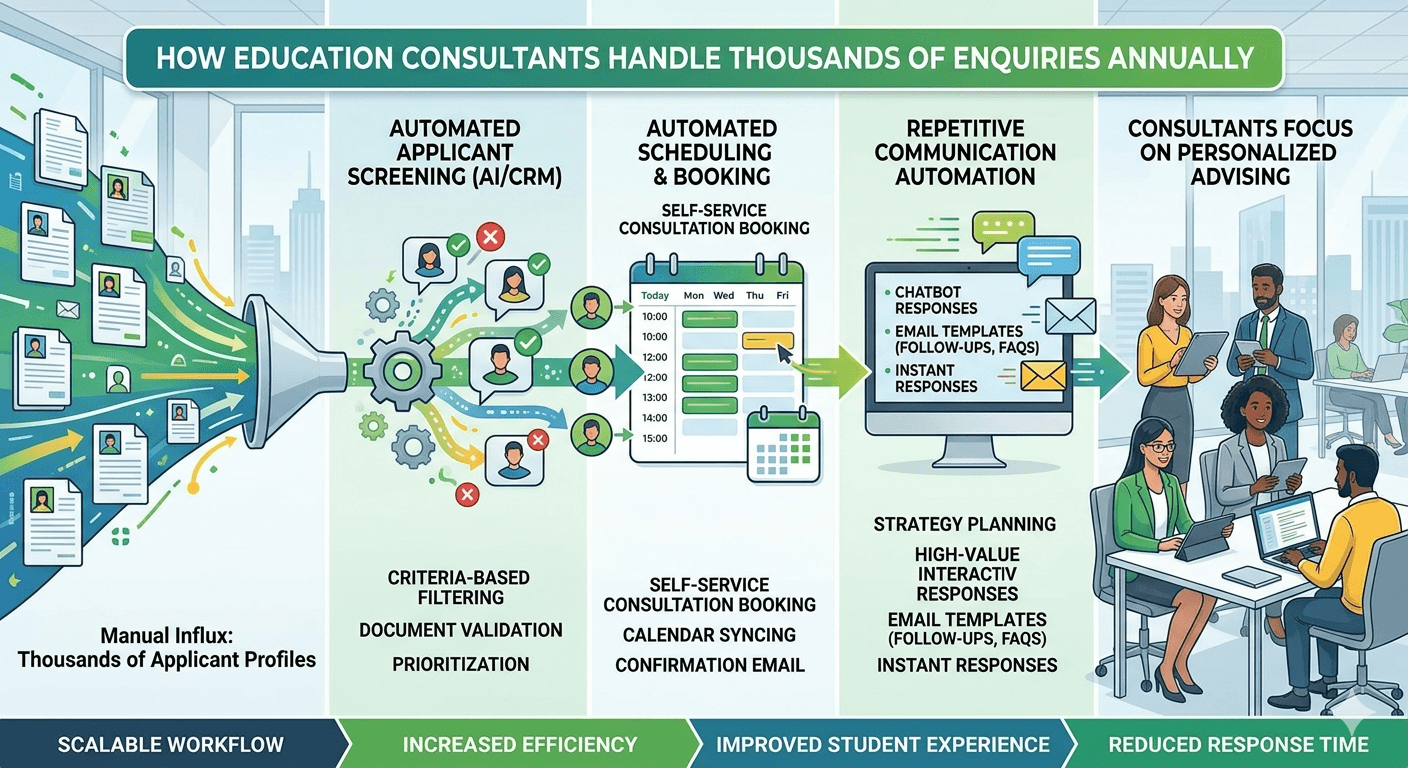
Education consultants receive large enquiry volumes. Learn how automation filters and schedules consultations efficiently.
Education and study abroad consultants in Chandigarh often operate in a high-volume, high-intent environment. A single campaign, referral burst, or seasonal intake cycle can generate hundreds or even thousands of enquiries in a short period. Many of those leads arrive with different goals: some want undergraduate admissions, others are applying for post-graduate programs, visa guidance, test preparation, or profile assessment. The operational challenge is not just collecting enquiries — it is sorting, qualifying, responding, and scheduling them fast enough so serious applicants do not drop off.
This is where AI automation for education consultants Chandigarh becomes practical, not theoretical. Instead of relying on a team to manually read every form submission, call every lead, and update every CRM record by hand, automation can screen applicants, route them based on intent, book consultations, and keep communication moving without delay.
In this article, we’ll break down the real workflow behind enquiry automation for education and study abroad consultancies, why manual processes break down, how AI systems can help, and what a realistic implementation looks like for a Chandigarh-based consulting business.
The Problem Education Consultants Face at Scale
Education consultancy is not a simple lead management business. The intake process is layered.
A single enquiry may require:
- verifying the destination country or course
- checking academic background
- confirming IELTS/PTE status
- understanding intake timelines
- identifying budget constraints
- deciding whether the lead is ready for consultation or still early-stage
That means every lead has multiple qualification points before a counsellor should spend time on a live call.
For smaller firms, a manual process may work when enquiries are low. But as the business grows, several issues appear:
1. Response time becomes inconsistent
A lead that is replied to within minutes is far more likely to engage than one that waits hours. Yet when counsellors are tied up with ongoing consults, document checks, and follow-ups, responses slow down.
2. High-intent leads get mixed with low-intent leads
Not every enquiry is ready to convert. Some students are exploring options casually. Others may not meet basic eligibility. Without structured qualification, teams spend too much time on leads that should have been filtered earlier.
3. Counsellors become overloaded
Your counsellors should be advising and closing serious applicants, not spending the day asking repetitive questions like:
- Which country are you targeting?
- What is your current qualification?
- When do you plan to apply?
- Have you taken a language test?
4. CRM records remain incomplete
If enquiry data is captured manually or inconsistently, the CRM becomes unreliable. That creates problems for follow-up, reporting, and team accountability.
For consultancies in Chandigarh and the wider Tricity market, these problems can become serious during peak admissions seasons. The solution is not simply hiring more staff. It is designing a workflow that handles volume intelligently.
Why Traditional Lead Handling Breaks Down
Manual lead handling fails because it depends on human reaction speed and memory.
Even a well-run team can run into the same operational bottlenecks:
- form submissions sit in inboxes before anyone reviews them
- leads are called once and never followed up properly
- counsellors ask the same questions repeatedly
- notes are entered into the CRM late or not at all
- no one knows which enquiry source is converting best
This creates hidden loss. Not every lost enquiry is visible. Some leads simply fade away because the response was too slow or the follow-up was too generic.
Traditional systems also fail to scale because education funnels are not linear. A student might:
- submit an enquiry form
- miss the first call
- reply by WhatsApp later
- request course options
- reschedule three times
- finally book a consultation
If your process is manual, each of those steps creates a chance for error.
This is why consultancies increasingly need lead response automation, qualification logic, and structured follow-up systems. In a broader sense, the same operational pattern is also seen in other service businesses that rely on high enquiry volumes, such as clinics and immigration firms, where timing and intake quality directly affect conversion.
How the AI Automation System Works
Lead form submission → trigger → AI qualification → CRM update → meeting booking → follow-up sequence
1. Lead form submission
The process begins when a student submits a form from a website, landing page, ad campaign, or WhatsApp entry point. The form should capture the essentials:
- name
- phone number
- preferred country
- course interest
- education level
- intake timeline
2. Trigger and routing
Once the lead enters the system, an automation trigger starts the qualification flow.
The lead can be routed based on:
- destination country
- course type
- urgency
- language test status
- budget range
- source campaign
3. AI qualification step
This is where an AI voice agent, chatbot, or automated SMS/WhatsApp sequence asks targeted questions to determine:
- seriousness
- eligibility
- readiness
- correct counsellor
4. CRM update
The system updates:
- lead status
- source
- country interest
- qualification score
- next action
- assigned counsellor
5. Meeting booking
Qualified leads are offered consultation slots immediately.
Practical Implementation for a Chandigarh Consultancy
Step 1: Define lead categories
- Hot → ready in 30–60 days
- Warm → exploring
- Cold → early research
- Unqualified → not fit
Step 2: Build intake form
Include:
- country
- intake
- qualification
- test status
- budget
- contact method
Step 3: CRM integration
Use systems like GoHighLevel.
Related:
CRM automation Chandigarh companies
Step 4: AI qualification layer
- WhatsApp → instant
- voice → fallback
- 3–5 questions
- booking if qualified
Step 5: Escalation logic
- complex → human
- high-value → senior counsellor
- no response → nurture
Step 6: Track outcomes
- qualification rate
- booking rate
- source quality
- drop-offs
Benefits and Strategic Impact
Faster response
Better counsellor utilization
Improved visibility
Better lead quality
Consistent follow-up
Scalable operations
Related Systems and Workflows
- AI voice agents for real estate Chandigarh
- AI missed call automation Chandigarh
- CRM automation Chandigarh companies
- AI lead response automation Chandigarh
- AI lead funnel Chandigarh
- AI conversion automation Chandigarh
- AI automation agency in Chandigarh
Frequently Asked Questions
How can AI automation help education consultants in Chandigarh?
It screens, qualifies, routes, books, and updates CRM automatically.
Is it useful for small consultancies?
Yes.
Can AI replace counsellors?
No.
What tools are used?
CRM + automation + messaging + voice.
Biggest mistake?
Automating only first response.
Conclusion
Education and study abroad consultancies in Chandigarh deal with a uniquely complex intake process. Leads are high volume, intent varies widely, and speed matters because serious applicants often compare multiple consultants before booking a meeting.
That is why AI automation education consultants Chandigarh is not just a buzzword — it is a practical way to manage enquiry volume, reduce repetitive work, and create a more reliable consultation pipeline. The best systems do not replace your counsellors. They prepare better leads for them, keep records clean, and ensure no enquiry is left waiting.
When implemented well, automation becomes an operational advantage: faster response, better qualification, stronger CRM visibility, and more predictable follow-up.
AI-native business systems
Bring a niche, or bring a workflow.
If you run the business, we build the system around it. If you sell into a niche, we build the system behind your offer.
PolarBuild case study →You sell the niche. We build the system.
We never compete for your end clients. One partnership conversation. You fulfil the same system across the accounts in your niche.
Free POC before dedicated software
A three-day sales demo of the system for your vertical before any large software investment. Implementation starts only when someone in that niche pays.
Replicate the niche, not a one-off build
UK dental becomes US dental with a new local partner and new integration targets. Same system thesis, new market.