
AI Voice Assistant
How AI Voice Agents Handle Missed Calls for Chandigarh Businesses

Updated
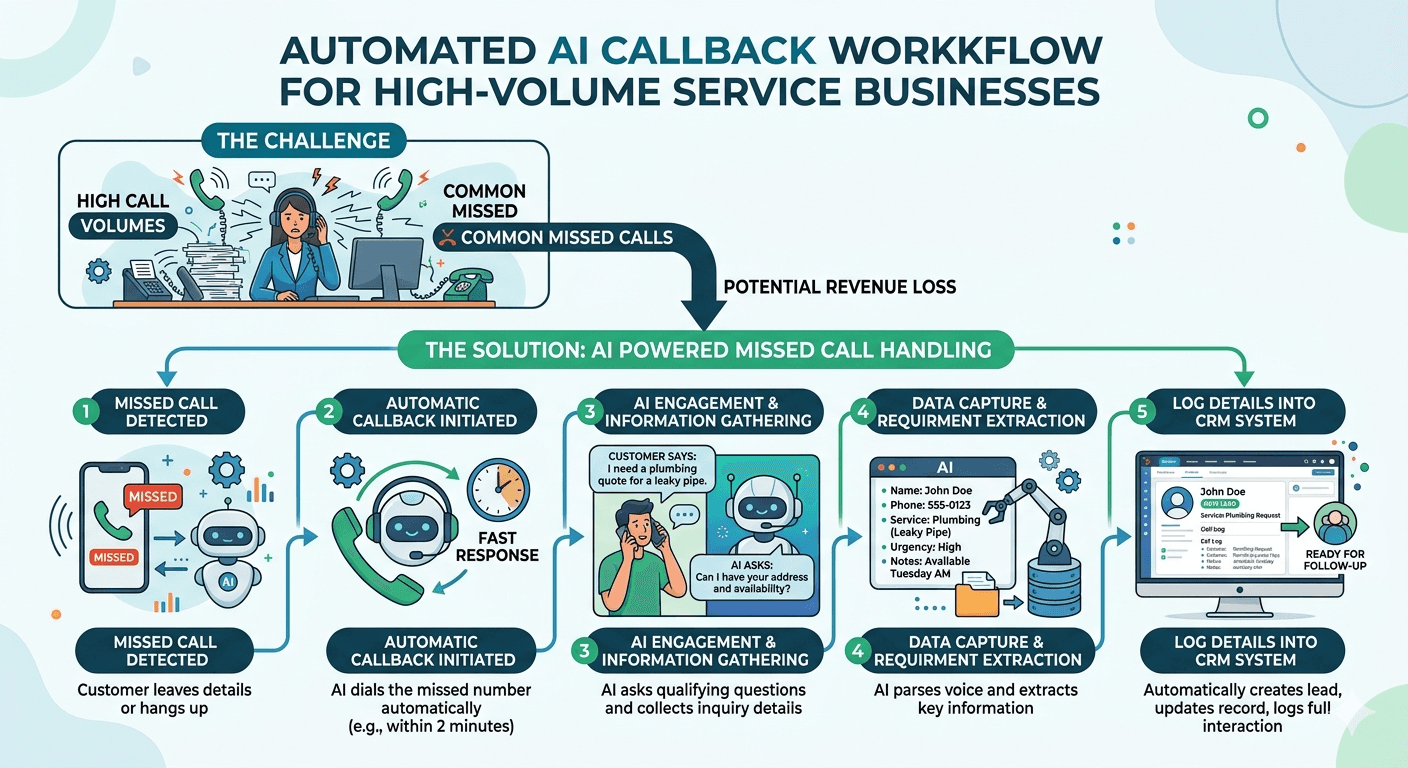
Missed calls often mean lost revenue. Discover how AI voice agents instantly return missed calls and capture enquiries automatically.
Missed calls are not a small operational issue for service businesses in Chandigarh, they are often missed revenue opportunities. A clinic misses a patient inquiry. A real estate office misses a property lead after hours. A coaching center misses a parent who called during a busy admissions window. By the time someone calls back manually, the prospect may already be speaking to a competitor.
This is exactly where missed call automation Chandigarh businesses are starting to use AI systems. Instead of letting unanswered calls disappear into call logs, an AI voice agent can trigger an immediate callback, ask the right questions, capture intent, and push the data into CRM workflows without requiring a human to chase every lead.
In this article, we’ll break down how AI voice agents handle missed calls, why traditional callback processes fail, what the automation workflow looks like, and how businesses can connect this system to CRM and lead follow-up processes. If you are evaluating broader AI automation services in Chandigarh, this is one of the most practical use cases to understand.
The Problem Businesses Face When Calls Go Unanswered
Missed calls are common in businesses that depend on inbound inquiries. The problem is not just that the phone rings unanswered. The real issue is that each missed call can represent a lead with high purchase intent.
This happens most often in businesses such as:
- Clinics and diagnostic centers
- Real estate agencies
- Immigration and visa consultancies
- Home services companies
- Education consultants
- Local service businesses with small front-desk teams
These businesses usually have the same operational pattern:
- Calls arrive during busy hours
- Staff are already handling walk-ins, appointments, or existing customers
- Some calls are missed
- Someone later checks the call log
- A manual callback happens, if time allows
That delay matters. In many cases, the caller is comparing options and simply moves on if nobody responds quickly. This is why AI callback systems are becoming more relevant: they reduce the time between first contact and follow-up from hours to seconds.
For businesses in Tricity that run on appointments, consultations, or scheduled visits, speed and consistency are not optional. They directly influence conversion rate.
Why Traditional Callback Processes Fail
A manual missed-call follow-up process looks simple on paper, but it breaks down quickly in real operations.
1. The callback is delayed
If a receptionist sees the missed call after 30 minutes or 2 hours, the lead’s intent may already be gone. For many categories, response time is part of the sale.
2. The caller may not answer on the second attempt
The first missed call is often followed by an unanswered callback. If the caller does not recognize the number or is busy, the opportunity fades further.
3. The team does not collect enough information
Even if someone answers the callback, the conversation may be inconsistent:
- What service do they need?
- When do they want it?
- Are they ready to book?
- Which branch or location matters?
Without structure, sales or front-desk teams often gather partial details only.
4. CRM data quality suffers
Manual notes end up scattered across:
- call logs
- WhatsApp messages
- spreadsheets
- desk notes
- CRM fields entered later
That makes lead tracking unreliable. This is why CRM automation Chandigarh companies matter: they help ensure every missed call becomes a structured record rather than an informal reminder.
5. Follow-up depends on memory
If the callback does not happen immediately, the next step often depends on someone remembering to do it later. That creates leakage in the pipeline.
Businesses that already care about speed-to-lead Chandigarh business performance usually discover that missed calls are one of the biggest hidden bottlenecks in the system.
How the AI Automation System Works
An AI voice agent does more than “call back.” It follows a structured workflow designed to recover missed intent and capture useful information.
Here is the typical workflow:
Missed call detected → automation trigger fired → AI voice agent calls back → caller intent is identified → qualification questions are asked → lead details are logged into CRM → next action is triggered
Let’s break that down.
1. Missed call detection
The phone system, telephony platform, or call tracking tool detects that a call was unanswered. That event becomes the trigger for automation.
2. Callback trigger
The system sends a callback request to the AI voice agent. This is where AI callback systems start operating in real time.
3. AI voice conversation begins
The AI voice agent answers in a natural, conversational manner:
“Hello, this is the virtual assistant from [business name]. We noticed you tried to reach us. How can I help you today?”
4. Intent capture and qualification
The AI asks short, relevant questions:
- What service are you looking for?
- Is this urgent?
- Which location do you want?
- What is the best time for a follow-up?
- Are you looking to book an appointment?
This aligns with broader AI lead qualification Chandigarh workflows.
5. CRM update
Once the call ends, the data is written into the CRM:
- caller name
- phone number
- service interest
- urgency
- call outcome
- callback time preference
6. Assignment or next step
The system can:
- create a task
- assign the lead
- send booking links
- trigger follow-ups
Often paired with AI lead response automation Chandigarh.
Practical Implementation: A Missed Call Workflow
Tools
- Phone system
- AI voice agent
- CRM (e.g., GoHighLevel)
- Automation workflows
- SMS/WhatsApp
- Calendar
Trigger Logic
- Instant callback
- Retry logic
- Human fallback
Sample Flow
- Missed call
- AI callback
- Qualification
- CRM entry
- Task/booking
- Confirmation message
Benefits and Strategic Impact
Faster response
Better lead capture
Improved CRM visibility
Less dependency on staff
Better handoff
Reliable pipeline
Related Systems
- AI lead response automation Chandigarh
- AI lead qualification Chandigarh
- CRM automation Chandigarh companies
- AI voice agents real estate Chandigarh
- AI automation agency in Chandigarh
FAQs
What is missed call automation?
A system that detects missed calls and triggers callbacks or workflows.
How do AI callback systems work?
They call back, qualify, and update CRM automatically.
Is this useful for small businesses?
Yes, especially for inbound-heavy businesses.
Can AI book appointments?
Yes, if connected to calendars.
Does this replace staff?
No, it supports them.
Conclusion
Missed calls are often treated like a minor inconvenience, but in practice they can be a major source of lost revenue. For Chandigarh businesses that rely on inbound enquiries, the gap between a missed call and a real follow-up can decide whether a lead converts or disappears.
AI voice agents solve this problem by creating an immediate callback workflow, collecting useful information, and logging the result into CRM systems without delay. When connected to the wider automation stack, this becomes much more than a callback feature, it becomes a structured lead recovery system.
If you are building a more reliable inbound process, missed call handling is one of the clearest places to start. It improves speed, consistency, and pipeline visibility while reducing manual effort. For businesses exploring deeper automation, this is a practical step toward a smarter AI-led sales and operations system.
AI-native business systems
Bring a niche, or bring a workflow.
If you run the business, we build the system around it. If you sell into a niche, we build the system behind your offer.
PolarBuild case study →You sell the niche. We build the system.
We never compete for your end clients. One partnership conversation. You fulfil the same system across the accounts in your niche.
Free POC before dedicated software
A three-day sales demo of the system for your vertical before any large software investment. Implementation starts only when someone in that niche pays.
Replicate the niche, not a one-off build
UK dental becomes US dental with a new local partner and new integration targets. Same system thesis, new market.