
Automated Lead Response
AI Automation for Facebook & Google Ads Leads in Chandigarh

Updated
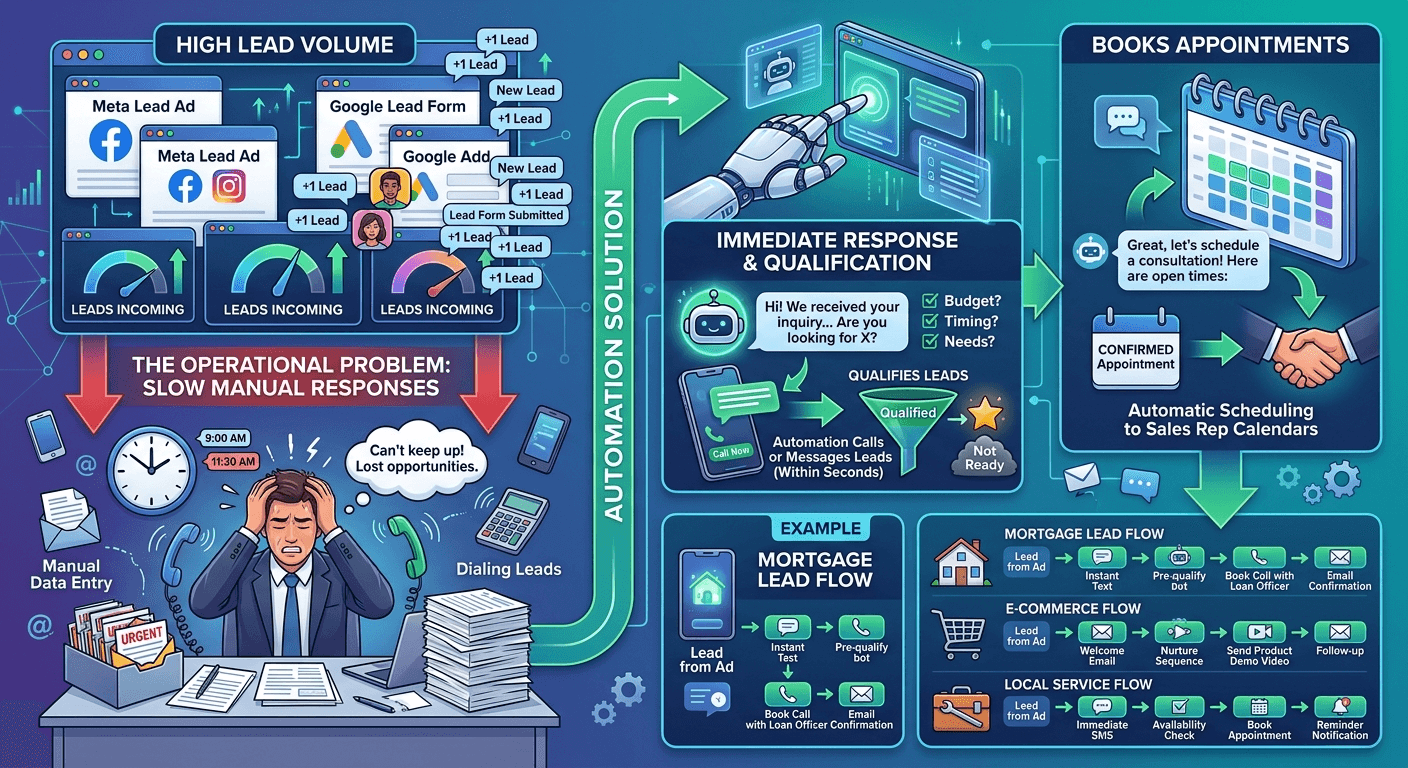
Paid ads generate leads quickly but most businesses respond too slowly. Discover how automation captures and qualifies ad leads instantly.
When a Chandigarh business runs Facebook Lead Ads or Google Ads, the biggest problem is rarely lead generation itself. The real challenge is what happens in the first 5 minutes after the lead arrives.
A home services company may get 30 enquiries in a day, a clinic may get form submissions after every campaign push, and an education consultant may receive dozens of leads from a single ad set. But if those leads sit in a spreadsheet, get assigned manually, or wait for a sales rep to call back later in the day, a large portion of the opportunity is already gone.
That delay creates a serious operational leak. The lead is still “fresh” in your CRM, but the buyer’s attention is not. They have already clicked on another ad, answered a competitor’s call, or moved on with their day. This is exactly where AI lead response automation Chandigarh businesses can use to close the speed gap.
In this article, we’ll break down how AI can instantly respond to Meta and Google leads, qualify them, route them, and book appointments automatically. You’ll also see practical workflows agencies use to turn paid traffic into actual sales conversations rather than delayed callbacks.
The Real Problem Businesses Face With Paid Ad Leads
Facebook and Google lead forms make it easier than ever to capture interest, but they also create a volume problem.
Most businesses in Chandigarh are not struggling to get leads. They are struggling to handle them well.
Typical operational issues include:
- leads coming in outside working hours
- sales teams missing form notifications
- duplicate follow-up efforts
- no consistent lead qualification process
- CRM records left incomplete
- ad spend being wasted on unresponsive leads
The issue becomes worse when teams rely on manual calling. A human rep can only contact so many leads per hour. They also need context, notes, and time to update the CRM after each conversation. That means even a well-intentioned team can end up responding too slowly.
For businesses in competitive categories like clinics, real estate, immigration, education, and local services, the difference between responding in 2 minutes and responding in 2 hours can completely change conversion performance.
This is why many agencies are now building Meta lead automation systems that react the moment a lead arrives, not when someone finally checks the inbox.
Why Traditional Lead Handling Fails
Manual lead follow-up sounds simple in theory:
- Lead submits form
- Sales rep receives notification
- Rep calls the lead
- Rep logs outcome in CRM
In practice, this workflow breaks down quickly.
1. Response time is too inconsistent
If a lead arrives when reps are busy, at lunch, or after hours, the response gets delayed. The problem is not just the delay itself. It is the inconsistency. Some leads are called immediately. Others wait 30 minutes or longer. That inconsistency creates predictable leakage.
2. Qualification is often incomplete
A rep may ask a few questions, but because they are rushing through many leads, they may forget critical qualifiers like budget, service need, location, or timeline. Without those details, it becomes hard to route leads correctly or prioritize follow-up.
3. CRM data quality suffers
Sales teams often dislike repetitive admin work. As a result, lead details may not be entered properly, stage updates are missed, and reporting becomes unreliable. That makes it hard for the owner or marketing team to know which ads are actually producing revenue.
4. Human capacity does not scale with ad spend
When ad budgets increase, lead volume increases. But human calling capacity does not increase at the same rate. A business can double ad spend and still keep the same number of reps. That mismatch creates bottlenecks.
5. Missed opportunities happen after the first contact attempt
A single unanswered call should not mean a lost lead. But in manual systems, if the lead is unreachable once, follow-up may be delayed or forgotten. Automation solves this by running multiple outreach steps automatically.
This is why many teams move beyond basic notifications and build a speed-to-lead Chandigarh business process that starts reacting in seconds, not hours.
How the AI Automation System Works
A strong lead response system is not just an AI phone call. It is a connected workflow that moves a lead from capture to qualification to booking.
A typical flow looks like this:
Lead form submission → webhook trigger → CRM record creation → AI call or SMS → qualification questions → routing decision → appointment booking → follow-up sequence
Let’s break that down.
Step 1: Lead arrives from Meta or Google Ads
The lead comes in through a Facebook Lead Ad, Google lead form, or landing page form. The trigger sends the data into your automation stack immediately.
Important fields often include:
- name
- phone number
- source campaign
- service interest
- city or area
- preferred contact time
Step 2: Automation creates or updates the CRM record
Before any outreach happens, the lead should be written into the CRM. This ensures the system has a single source of truth.
A good workflow checks for:
- duplicates
- existing contact history
- existing deal stage
- assigned owner
- campaign source
This is where CRM automation Chandigarh companies often see the biggest improvement. Clean data is not just an admin benefit. It determines whether routing, reporting, and follow-up actually work.
Step 3: AI responds instantly by voice, SMS, or both
Depending on business type, the automation can:
- place an AI voice call
- send an SMS or WhatsApp-style message
- email the lead
- trigger a task for a human rep if needed
Voice works well when you need qualification quickly. SMS works well when the lead may not pick up immediately. Many businesses use both.
For example:
- voice first for high-intent leads
- SMS fallback if the call is missed
- manual follow-up only for qualified or high-value leads
Step 4: Qualification questions are asked
The AI agent can ask structured questions like:
- What service do you need?
- How soon are you looking to get started?
- What is your budget range?
- Which location are you interested in?
- Are you speaking to compare options or ready to book?
The goal is not to interrogate the lead. It is to identify intent and urgency fast.
This is similar in concept to the workflows used in AI lead qualification Chandigarh systems, where the automation filters low-intent enquiries before sales teams spend time on them.
Step 5: The lead is routed based on answers
Once qualification is complete, the system decides what to do next.
Examples:
- hot lead → book appointment immediately
- medium-intent lead → send nurture sequence
- low-intent lead → place into long-term follow-up
- wrong location/service → mark as disqualified
This is where automation creates real operational leverage. The business is no longer treating every lead the same way.
Step 6: CRM updates and booking happen automatically
The final step is the handoff.
The CRM should update with:
- call outcome
- qualification notes
- lead stage
- next action
- appointment time if booked
If the lead is qualified, the system can create a meeting, assign the salesperson, and notify the team instantly.
That means the sales team spends time on conversations, not repetitive triage.
Practical Implementation: A Mini Playbook for Chandigarh Businesses
Let’s say a clinic in Chandigarh is running Google Ads and Facebook lead campaigns for consultation bookings.
They receive lead forms from people interested in:
- skin treatment
- dental consultation
- preventive health checkups
Here is how a practical automation stack may work.
Tools involved
A typical setup may include:
- Meta Lead Ads or Google Lead Forms
- webhook connector or automation platform
- CRM such as GoHighLevel
- AI voice agent
- SMS/email integration
- calendar booking system
- pipeline stages in CRM
Workflow design
Trigger
A lead submits a form from a paid ad.
Immediate response
The system triggers a voice agent or SMS within seconds.
Qualification
The AI asks:
- Which treatment are you interested in?
- How soon would you like an appointment?
- Have you visited before?
- Which day suits you for a consultation?
Decision logic
- If the lead wants to book now, the system sends scheduling options
- If the lead is uncertain, it creates a follow-up task
- If the lead is unreachable, it retries after a short delay
CRM action
The automation tags the lead by source and intent level.
Booking
If the lead confirms interest, the appointment is booked and assigned to the correct staff member.
Example routing logic
A real business might use logic like this:
- lead from Google search ads with urgent intent → immediate call
- lead from Meta awareness campaign → SMS first, then voice follow-up
- existing customer → bypass qualification and route directly to service desk
- duplicate lead → merge and update rather than create a new record
This is where AI voice agents become especially useful, because they can respond at scale without waiting for office hours.
If the business is already using structured follow-up systems, this also connects naturally with AI voice agent GoHighLevel integration, where calls, pipeline stages, and appointment booking are all tied together.
What Agencies Usually Build for This Use Case
Agencies working on lead response systems usually do not stop at one automation. They build a stack of workflows that work together.
Common components include:
- instant lead response
- qualification call
- missed-call recovery
- reminder sequences
- no-show follow-up
- reactivation of old leads
For service businesses, this becomes especially powerful when combined with broader AI conversion automation Chandigarh workflows that keep the pipeline active beyond the first contact.
A well-designed system should answer three questions:
- Did we respond fast enough?
- Did we qualify correctly?
- Did we move the lead to the next step?
If the answer to any of these is no, then the system needs refinement.
Benefits and Strategic Impact
The biggest benefit of AI lead response automation is not “using AI.” It is improving pipeline efficiency.
Faster response times
Leads are contacted immediately after submission. That alone increases the chance of reaching them while intent is high.
Better lead quality
Automation can screen out poor-fit enquiries before they consume sales time.
More consistent follow-up
Unlike manual calling, automated workflows do not forget, stall, or depend on someone remembering the task later.
Cleaner data
When the CRM is updated automatically, owners get more accurate reporting on sources, qualification rates, and booked appointments.
Better use of sales team time
Reps spend more time on serious leads and less time on repetitive outreach.
Improved campaign visibility
You can see which ad campaigns generate not just leads, but qualified conversations and bookings.
For businesses thinking more strategically, this is not just a lead-handling improvement. It is part of a larger system design that often fits under an AI automation agency in Chandigarh model, where ad traffic, CRM, and follow-up are treated as one connected pipeline.
Related Systems and Workflows That Strengthen Lead Response
Lead response automation works best when it is connected to surrounding workflows rather than implemented in isolation.
Voice agents for high-intent industries
If your ad leads are high-value or time-sensitive, voice outreach is often the fastest way to qualify. This is especially relevant in sectors like property, healthcare, and admissions. For example, businesses can pair lead response flows with AI voice agents for real estate Chandigarh when enquiries need immediate property qualification and appointment setting.
CRM automation after qualification
Once a lead is qualified, the next problem is pipeline management. If the deal stage, owner, or next action is not updated correctly, the advantage of instant response gets lost. That is why lead response systems should be tied to a clean CRM process, similar to what is covered in CRM automation Chandigarh companies.
Sales follow-up systems for non-responsive leads
Not every lead answers on the first attempt. Some need multiple touchpoints. A structured system can move missed calls, unopened messages, and non-responsive leads into a follow-up sequence. This is closely related to the workflows used in AI missed call automation Chandigarh, where the system recovers lost opportunities after the initial contact fails.
Sales team support for qualification and handoff
In some businesses, AI handles first response while humans handle closing conversations. That hybrid model works well for teams that want scale without losing personal interaction. It also connects to the broader role of AI SDR Chandigarh sales teams, where automation prepares leads before human reps take over.
FAQs
How fast should a business respond to Facebook or Google leads?
Ideally within minutes. The faster the response, the higher the chance the lead is still engaged and reachable.
Can AI qualify leads before a human salesperson speaks to them?
Yes. AI can ask structured questions to determine need, urgency, budget, and fit before handing the lead to a sales rep.
Is this only useful for large companies?
No. Small and mid-sized businesses often benefit the most because they usually have less tolerance for wasted leads and limited sales capacity.
Does lead response automation replace the sales team?
No. It handles repetitive first-response work so the sales team can focus on qualified conversations and closing.
What tools are commonly used for this kind of automation?
Many businesses use a CRM, automation platform, AI voice system, calendar booking tool, and form/webhook integration connected together.
Conclusion
For businesses running Facebook and Google Ads in Chandigarh, lead generation is only half the job. The real performance difference comes from how quickly and consistently those leads are handled.
AI lead response automation solves the bottleneck between enquiry and conversation. It reduces delay, improves qualification, keeps CRM data organized, and helps sales teams focus on leads that are actually ready to move forward.
When built properly, this is not a gimmick. It is an operational system that turns paid traffic into a structured pipeline.
If your business is spending on ads but still relying on manual callbacks and delayed CRM updates, it may be time to think about a more connected workflow through an experienced AI automation services in Chandigarh partner.
AI-native business systems
Bring a niche, or bring a workflow.
If you run the business, we build the system around it. If you sell into a niche, we build the system behind your offer.
PolarBuild case study →You sell the niche. We build the system.
We never compete for your end clients. One partnership conversation. You fulfil the same system across the accounts in your niche.
Free POC before dedicated software
A three-day sales demo of the system for your vertical before any large software investment. Implementation starts only when someone in that niche pays.
Replicate the niche, not a one-off build
UK dental becomes US dental with a new local partner and new integration targets. Same system thesis, new market.