
Automation
AI Automation for Home Service Businesses in Chandigarh

Updated
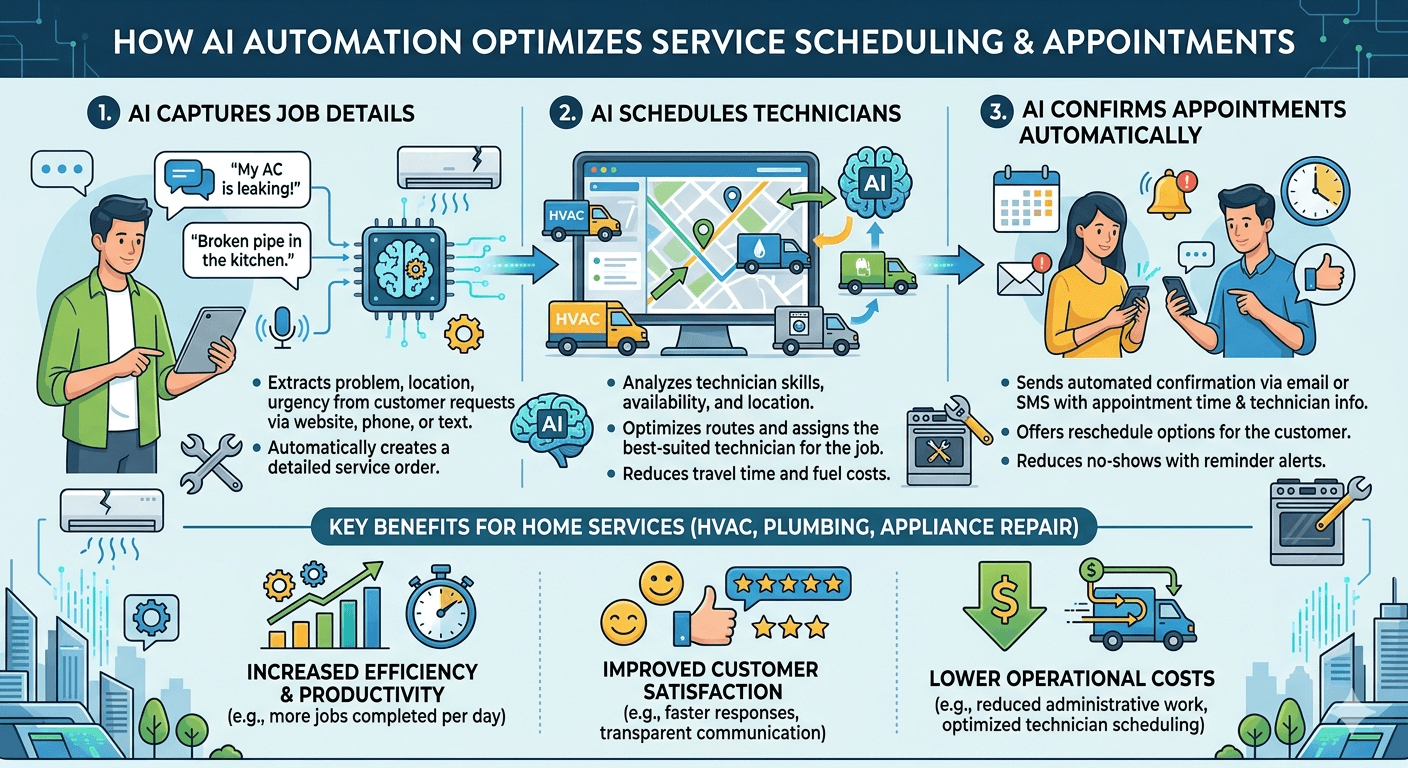
Home service companies depend on fast responses to enquiries. Learn how automation captures service requests instantly.
A plumbing company in Chandigarh gets three missed calls during a busy morning. By the time someone checks the phone, two callers have already booked elsewhere and the third has stopped answering. A technician is available, but no one has captured the job details, no one has assigned the right service type, and no appointment has been confirmed. This is the exact kind of operational leak that quietly costs home service businesses revenue every day.
For HVAC, plumbing, appliance repair, pest control, and maintenance companies, speed matters more than almost anything else. Customers usually reach out because they need help now, not later. If the response is slow, the lead goes cold. If the intake process is manual, details get missed. If scheduling depends on a human remembering to follow up, jobs slip through the cracks.
That is where AI automation home services Chandigarh businesses can use to create a faster, more reliable intake and booking process. In this article, we’ll break down how AI automation captures service requests instantly, qualifies the job, schedules the right technician, and confirms the appointment automatically, without forcing the office team to do everything manually.
The Problem Home Service Businesses Face
Home service businesses have a different operational rhythm than many other industries. Leads are not just “inquiries”; they are service requests with urgency, location, timing, and technical details. A customer may need a same-day HVAC repair, an emergency plumbing visit, or a doorstep appliance diagnosis. That means the intake workflow has to be fast, structured, and accurate.
The challenge is that many businesses still rely on:
- phone calls answered by one or two staff members
- WhatsApp messages with incomplete details
- manual note-taking on paper or in spreadsheets
- follow-up calls made later in the day
- technicians being scheduled after someone reviews the request manually
This creates several operational problems:
1. Missed calls become missed jobs
If the team is busy on another line, the customer may move on to a competitor.
2. Incomplete job data slows dispatch
Without exact service type, location, urgency, and preferred time, it’s hard to assign the right technician.
3. Scheduling becomes reactive
The office team spends time chasing details instead of dispatching efficiently.
4. Confirmation gaps create no-shows
Customers forget appointments unless they receive immediate confirmation and reminders.
5. CRM data is inconsistent
Jobs may be recorded differently depending on who answered, which makes reporting and follow-up harder.
For Chandigarh-based service companies operating across the city and nearby Tricity areas, these issues are especially painful because response time can be the deciding factor. A business may have skilled technicians, but if the front-end process is slow, the back-end capacity never gets used properly.
Why Traditional Approaches Fail
Manual intake works only when volume is low and the team is always available. In real operations, that rarely happens.
1. Human response time is inconsistent
Even a well-run office cannot answer every call instantly. Staff may be on another line, out for lunch, handling invoices, or coordinating with technicians. That delay is enough for some leads to disappear.
2. Repetitive data collection wastes time
Every service request requires similar questions:
- What service is needed?
- What is the address?
- Is it urgent?
- What brand or equipment type is involved?
- When can the technician visit?
A human answering these questions every time is not scalable.
3. Qualification is often incomplete
A receptionist may take the name and phone number, but not enough detail to decide whether the job is emergency, routine, or outside the business’s service area. That creates back-and-forth later.
4. CRM updates happen late or not at all
If the lead is written down first and entered later, errors creep in. Job details can be missing, appointment times can be wrong, and follow-up reminders may never get created.
5. Follow-up depends on memory
A home service lead is highly time-sensitive. If someone says “call me in an hour,” that follow-up must happen on time. Manual reminders break under pressure.
How the AI Automation System Works
A good automation system for home services is not just a chatbot. It is a structured intake and scheduling workflow that captures information, routes it correctly, and confirms the next step.
Flow:
Lead form / missed call / website chat / WhatsApp message → automation trigger → AI assistant collects details → qualification rules → technician matching → CRM update → appointment booking → confirmation message
1. Lead capture trigger
The workflow starts when a customer reaches out through one of these entry points:
- website contact form
- service booking form
- missed call callback trigger
- WhatsApp inquiry
- Facebook lead form
- Google Business Profile call or message
Once the inquiry is received, automation triggers instantly.
2. AI collects service details
The system asks for the essential information:
- full name
- phone number
- service type
- address or locality
- urgency level
- preferred time
- equipment brand or issue description
This can happen through chat, voice, or a call-back agent.
If you want to see how voice-based intake can work in another industry, the logic is similar to
AI voice agents for real estate Chandigarh
3. Qualification rules are applied
- emergency vs non-emergency
- service area vs out of area
- warranty or paid service
- residential vs commercial
- one-time vs recurring
- technician specialization
4. Technician matching happens automatically
- availability
- skill set
- location
- time window
- workload balance
5. CRM record is created or updated
Every lead should be logged with:
- customer name
- service type
- source channel
- status
- appointment
- technician
- notes
Related:
CRM automation Chandigarh companies
6. Appointment is confirmed
Customer receives:
- service summary
- date/time
- technician details
- contact info
- rescheduling option
7. Reminder and follow-up steps run automatically
- reminders
- updates
- rescheduling
Practical Implementation: A Mini Playbook
Step 1: Capture every inquiry
- website
- missed calls
- ads
- voice
Step 2: Ask the right intake questions
- service
- location
- urgency
- issue
- timing
Step 3: Set routing logic
- emergency → priority
- routine → schedule
- specialist → assign
- outside area → reject
Step 4: Connect CRM and calendar
Tags:
- HVAC
- repair
- new/repeat
- priority
Step 5: Send confirmation immediately
Step 6: Notify technician
Step 7: Add reminder automation
Benefits and Strategic Impact
Faster speed-to-lead
Better conversion
Less admin work
Cleaner data
Better technician utilization
Professional experience
Better demand visibility
Related Systems and Workflows
- AI automation service business Chandigarh
- AI lead response automation Chandigarh
- AI missed call automation Chandigarh
- speed-to-lead Chandigarh business
- AI automation agency in Chandigarh
Frequently Asked Questions
What types of home service businesses can use AI automation?
HVAC, plumbing, appliance repair, electricians, pest control, maintenance.
Can AI handle emergency requests?
Yes, with priority routing.
Does AI replace staff?
No, it supports them.
What tools are used?
CRM, automation, messaging, voice.
Is it useful for small businesses?
Yes, especially.
Conclusion
For home service businesses in Chandigarh, the biggest operational advantage is not just better marketing, it is faster and more reliable response handling.
When service requests are captured instantly, job details are structured properly, technicians are scheduled intelligently, and appointments are confirmed automatically, the business becomes easier to run and easier for customers to trust.
That is the real value of AI automation: removing friction from the highest-pressure part of the customer journey.
AI-native business systems
Bring a niche, or bring a workflow.
If you run the business, we build the system around it. If you sell into a niche, we build the system behind your offer.
PolarBuild case study →You sell the niche. We build the system.
We never compete for your end clients. One partnership conversation. You fulfil the same system across the accounts in your niche.
Free POC before dedicated software
A three-day sales demo of the system for your vertical before any large software investment. Implementation starts only when someone in that niche pays.
Replicate the niche, not a one-off build
UK dental becomes US dental with a new local partner and new integration targets. Same system thesis, new market.