
Automation
AI Automation Workflows for Chandigarh Service Businesses

Updated
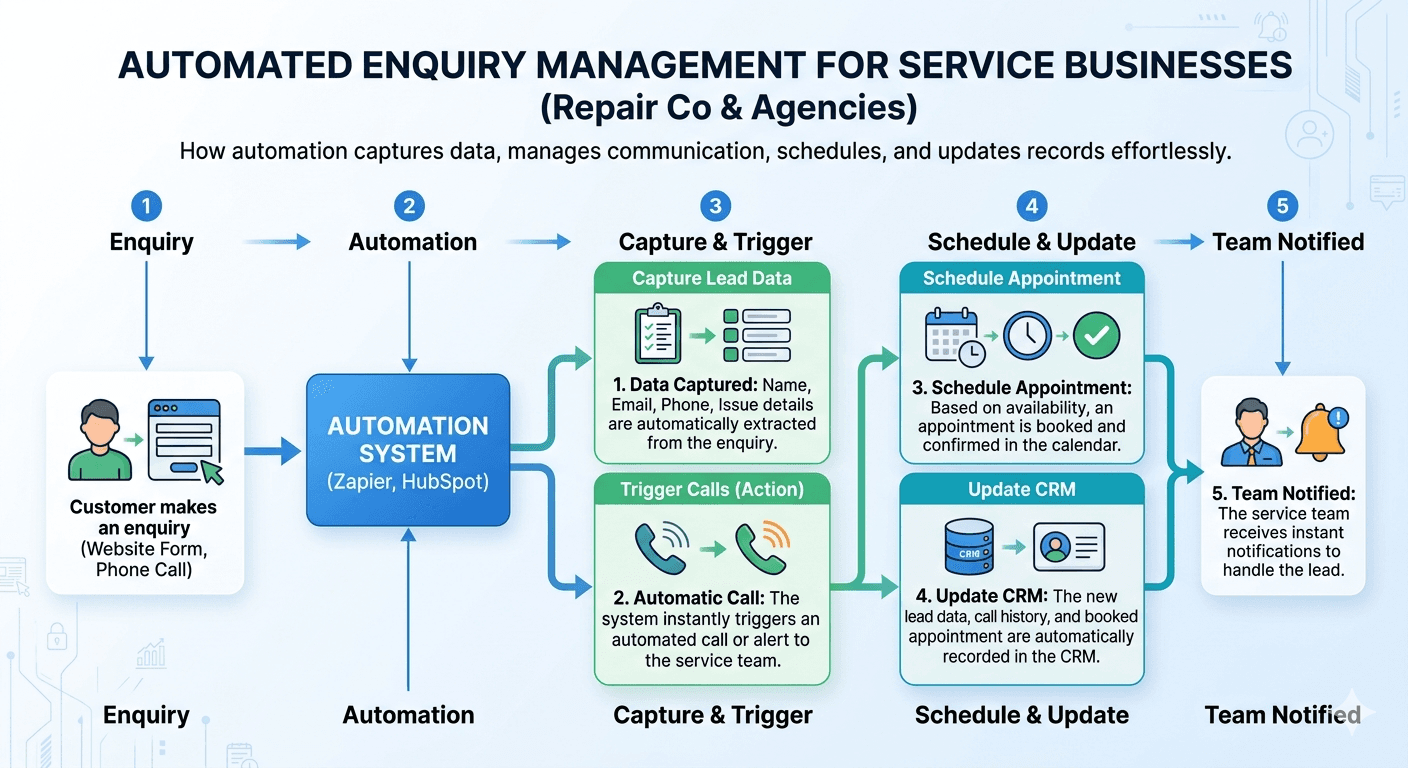
Service businesses depend on quick responses to enquiries. Discover automation workflows that improve customer response times.
A typical service business in Chandigarh does not lose leads because of a lack of demand. It loses leads because the response process is too slow, too manual, or too inconsistent. A customer fills out a contact form, calls after hours, sends a WhatsApp message, or leaves a missed call—and then the enquiry sits in a spreadsheet, an inbox, or a shared phone waiting for someone to notice it. By the time a human follows up, the prospect may already be speaking with another provider.
This is especially common for repair companies, agencies, consultants, and local service firms that depend on fast enquiry handling. The challenge is not just getting leads; it is capturing the lead, qualifying it, routing it, and moving it into a pipeline without delay.
That is where AI automation workflows for Chandigarh service businesses become valuable. In this article, we will break down how automation captures lead data, triggers calls or messages, schedules appointments, updates the CRM, and keeps the pipeline moving with far less manual work.
The Problem Service Businesses Face
Service businesses usually operate with a mix of inbound enquiries, phone calls, referrals, and follow-up conversations. In theory, this looks simple. In practice, the process is messy.
A repair company may receive:
- website form submissions
- Google Business Profile calls
- missed calls from mobile phones
- WhatsApp messages
- repeat customer enquiries
- outbound follow-up responses
An agency may get:
- discovery call requests
- lead magnet downloads
- paid ad enquiries
- contact form submissions
- LinkedIn or referral leads
The core issue is that these enquiries do not enter the sales process in a structured way. One person checks email, another checks the phone, and someone else updates the CRM later if they remember.
That creates several operational problems:
- response times become inconsistent
- lead details are entered manually and often incorrectly
- no one knows which leads are hot
- appointment booking gets delayed
- follow-up happens too late
- the CRM becomes unreliable
When a business has no systematic lead pipeline automation, even good leads can go cold. For service businesses in competitive local markets, speed and consistency matter as much as the offer itself.
Why Traditional Approaches Fail
Many service businesses still depend on manual handling because it feels easier to control. But manual systems usually fail in the exact moments that matter most.
1. Delayed responses
A lead that waits 30 minutes or more is already less likely to convert. If the enquiry comes in after hours, the delay can stretch to several hours or even the next day. In that gap, the customer may contact three other businesses.
2. Missed enquiries
Phone enquiries are especially vulnerable. If the call is missed and no automatic follow-up is triggered, the lead may never be recovered. This is one reason
AI missed call automation in Chandigarh
has become such a practical workflow for local businesses.
3. Poor qualification
Not every lead is worth the same level of attention. Some enquiries are urgent, some are low-budget, and some are not in the service area. Without structured qualification, teams waste time chasing poor-fit leads while high-intent leads wait.
4. Inaccurate CRM data
Manual entry creates weak records. Names are misspelled, phone numbers are incomplete, and source tracking is lost. Later, the business cannot tell which campaigns, channels, or services are producing real opportunities.
5. No follow-up discipline
A lot of businesses assume follow-up happens “naturally.” In reality, it often depends on memory. If the team is busy, follow-up gets postponed. That is why many firms build
CRM automation workflows for Chandigarh companies
to keep records and tasks updated automatically.
How the AI Automation System Works
Flow:
Lead → trigger → AI response → qualification → CRM update → booking/handoff
Step 1: Lead enters from a source
- website form
- landing page
- call
- missed call
- ads
- chat
Step 2: Automation trigger fires
- webhook
- CRM trigger
- call event
- form submission
Step 3: Lead data is captured
- name
- phone
- service
- location
- source
- timestamp
Step 4: AI initiates contact
- call
- SMS
Related:
AI voice agent GoHighLevel integration
Step 5: Qualification
- service need
- urgency
- location
- budget
- timing
Step 6: CRM updates
- status
- notes
- priority
- stage
- assignment
Step 7: Booking or handoff
- appointment
- task
- notification
Practical Implementation
Scenario
Customer submits form at night → system responds instantly → qualification → booking → CRM updated
Example workflow
- Form submitted
- Data stored
- Service area check
- Priority assigned
- Instant reply
- AI call/message
- Qualification
- CRM update
- Team notified
- Booking or follow-up
Tools
- CRM
- forms
- automation
- AI call/messaging
- calendar
- notifications
Related system
AI automation stack in Chandigarh for startups
Benefits
- faster response
- better qualification
- cleaner CRM
- lower admin load
- reliable pipeline
- better visibility
Related Systems
- AI lead response automation in Chandigarh
- AI lead qualification in Chandigarh
- AI CRM reactivation in Chandigarh
- AI conversion automation in Chandigarh
- AI automation for service businesses in Chandigarh
- AI automation agency in Chandigarh
FAQs
What are AI automation workflows?
Systems that capture, qualify, and route leads automatically.
Who benefits most?
Service businesses with inbound leads.
Do I need complex tools?
No, start simple.
Does it replace staff?
No, it supports them.
Conclusion
For Chandigarh service businesses, the biggest operational risk is not a lack of leads. It is the delay, inconsistency, and manual effort involved in handling those leads properly.
AI automation workflows solve that by capturing enquiries instantly, qualifying them, updating the CRM, and pushing the right next step without unnecessary friction.
When built well, these systems improve speed-to-lead, reduce missed opportunities, and make the pipeline much easier to manage.
If your business depends on enquiries, appointments, and fast response times, this is one of the most practical ways to improve performance without adding more administrative overhead. Exploring AI automation services in Chandigarh is a strong next step.
AI-native business systems
Bring a niche, or bring a workflow.
If you run the business, we build the system around it. If you sell into a niche, we build the system behind your offer.
PolarBuild case study →You sell the niche. We build the system.
We never compete for your end clients. One partnership conversation. You fulfil the same system across the accounts in your niche.
Free POC before dedicated software
A three-day sales demo of the system for your vertical before any large software investment. Implementation starts only when someone in that niche pays.
Replicate the niche, not a one-off build
UK dental becomes US dental with a new local partner and new integration targets. Same system thesis, new market.