
Automation
Building an AI Automation Stack for Chandigarh Startups

Updated
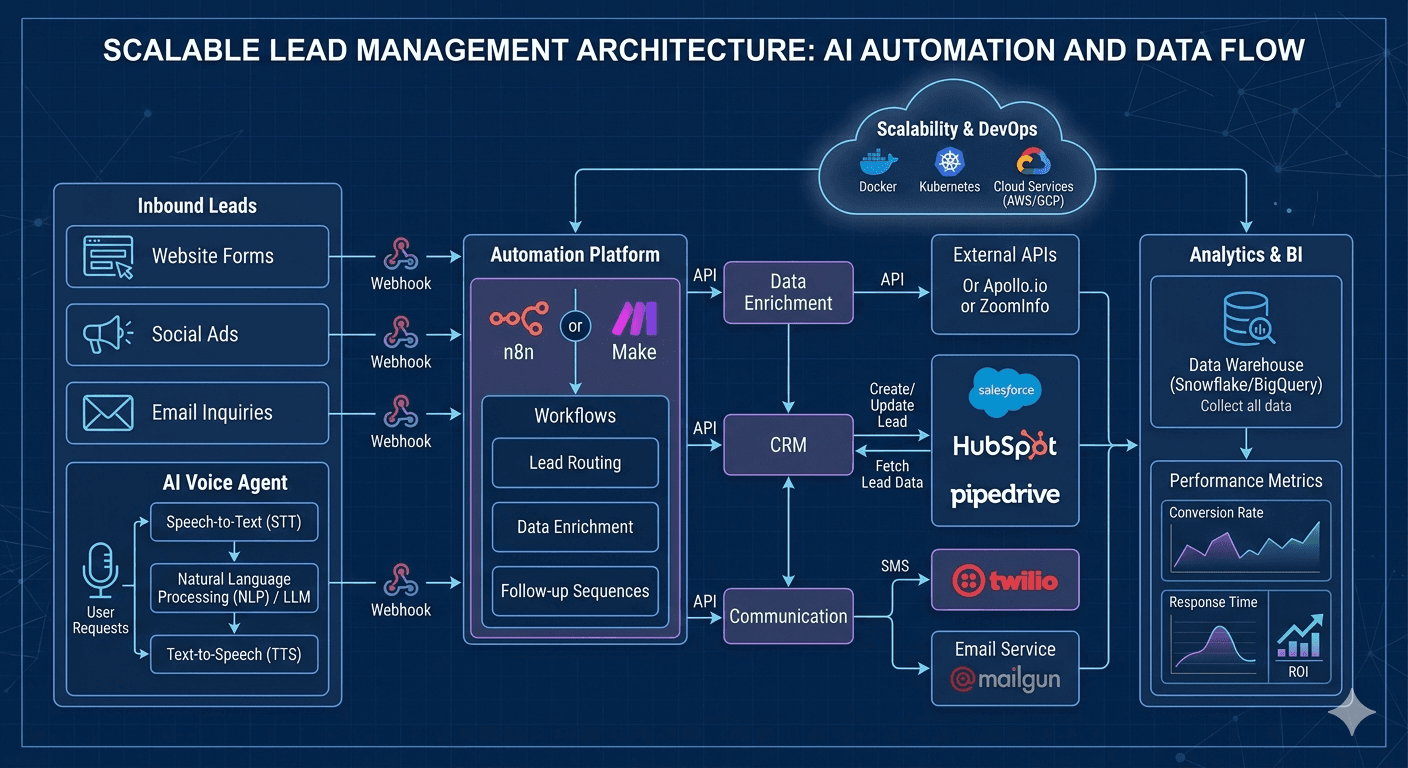
Startups near Chandigarh IT Park are adopting automation rapidly. Learn the tech stack behind modern AI automation systems.
A startup near Chandigarh IT Park might generate interest from 30 leads in a week, but if those enquiries sit in a spreadsheet until someone has time to call back, the opportunity is already leaking. The real bottleneck is rarely demand. It is the system between lead capture, qualification, response, and follow-up. That system often depends on people remembering tasks, manually updating CRM records, and forwarding messages between sales, operations, and support.
Modern AI automation solves that bottleneck by turning lead handling into an engineered workflow rather than a manual routine. Instead of “someone checks the form later,” the stack can trigger a webhook the moment a lead arrives, send the lead through a scoring or qualification layer, launch an AI voice call or message sequence, update the CRM, and route the lead to the right salesperson or pipeline stage automatically.
In this article, we’ll break down the AI automation stack startups in India are using, the technical architecture behind it, and how Chandigarh businesses can design scalable lead management pipelines without overcomplicating their operations. We’ll also look at how tools like n8n, Make, CRMs, voice agents, and analytics fit together inside a practical automation architecture for sales.
The Problem Startups Face When Lead Handling Grows
Most early-stage startups begin with a simple setup: website forms, WhatsApp messages, inbound calls, and a sales rep who manually follows up. That works when enquiry volume is low. It breaks as soon as lead flow becomes inconsistent or multi-channel.
The main problems are usually the same:
- Leads arrive from multiple sources: website, ads, landing pages, referrals, calls, and social platforms.
- Response time varies depending on who is available.
- Sales teams forget to log details in the CRM.
- Follow-up is inconsistent across hot, warm, and cold leads.
- Managers cannot reliably see where leads are dropping.
For startups in Chandigarh, Mohali, and the wider Tricity market, this is especially common in service businesses, SaaS, education, real estate, healthcare, and consulting. When each new lead matters, manual processing becomes a revenue risk.
The issue is not simply “too much work.” It is the lack of an integrated system that can convert inbound demand into a structured pipeline. That is why startup teams increasingly need an AI automation stack startups India can actually maintain, rather than a patchwork of disconnected tools.
Why Traditional Sales Processes Fail at Scale
Manual workflows fail because they depend on human consistency in places where speed and repetition matter most.
1. Response delays destroy intent
Inbound leads have short attention windows. If a prospect fills out a form and waits 30 minutes, the chance of engagement falls sharply. If the same lead gets an immediate callback or personalized message, intent stays high.
This is why speed-to-lead systems matter. A delay is not just an operational inconvenience; it is a conversion leak.
2. CRM data becomes unreliable
When reps manually update notes, stages, and follow-up reminders, data quality degrades. Some entries are incomplete. Some are delayed. Some never get logged at all. That means the CRM stops being a source of truth.
3. Qualification is inconsistent
One rep may consider a lead qualified after budget confirmation. Another may wait for location, urgency, or service fit. Without a defined workflow, pipeline stages become subjective.
4. Follow-up breaks down
The majority of deals are not won on the first touch. They are won through structured follow-up. But manual follow-up depends on memory and discipline. That creates gaps, especially when teams are busy.
5. Managers lack operational visibility
Without automation, it becomes difficult to answer basic questions:
- Which source generates the highest-quality leads?
- Which stage has the most drop-offs?
- Which rep responds fastest?
- How many leads were contacted within 5 minutes?
These are architecture problems, not just sales problems.
How the AI Automation System Works
A robust AI lead system is not one tool. It is a chain of components that passes information from one stage to the next.
Flow:
Lead form / call / chat → webhook trigger → enrichment or validation → AI voice or message response → qualification → CRM update → routing → booking or follow-up → analytics
1. Lead capture
The process begins when a lead enters from a form, phone call, chatbot, Facebook ad, landing page, or inbound WhatsApp message. The capture layer should normalize the data into a standard format.
Typical fields:
- name
- phone number
- source
- service interest
- city or location
- timestamp
2. Webhook trigger
A webhook is the event bridge. As soon as a new lead is captured, the system sends the data to automation software such as n8n or Make.
3. Validation and enrichment
Before acting on the lead, the system can check:
- is the phone number valid?
- is the email deliverable?
- is the source correct?
- does the lead already exist in the CRM?
4. AI response layer
Depending on the business model, the AI layer can:
- send a WhatsApp or SMS reply
- place an outbound call through a voice agent
- answer basic questions in chat
- ask qualification questions
- route the lead to a human if needed
For example, a startup may use a voice agent to immediately call a high-intent lead and ask a small set of questions such as timeline, budget, and service need. This is especially useful in systems discussed in posts like AI lead qualification in Chandigarh, where first-contact structure matters more than volume.
5. Qualification logic
The system should not treat every lead the same. It needs business rules.
Examples:
- If lead says “urgent,” mark as hot.
- If the lead is outside the service area, tag as low priority.
- If budget fits the target range, move to sales queue.
- If no answer after two attempts, start nurture sequence.
6. CRM update
Once the lead is classified, the CRM must be updated automatically with:
- stage
- lead source
- call outcome
- notes
- next step
- owner assignment
7. Routing and scheduling
Qualified leads should be routed to the correct person or team. In some cases, the system should schedule meetings automatically if the lead meets a predefined threshold.
This is where systems overlap with CRM automation for Chandigarh companies, especially when sales teams need structured handoff between automation and human follow-up.
8. Analytics and monitoring
Finally, the system should record performance data:
- response time
- contact rate
- qualification rate
- meeting booking rate
- source performance
- drop-off points
Without analytics, automation is guesswork.
Practical Implementation: A Mini Playbook for Startups
Scenario
A startup runs lead generation campaigns for a service business. Leads come from website forms and ad landing pages. The goal is to contact each lead within minutes, qualify interest, and push high-intent prospects into the CRM for immediate sales follow-up.
Recommended tools
A practical stack might include:
- Website form: Webflow, WordPress, or custom form
- Automation engine: n8n or Make
- CRM: GoHighLevel, HubSpot, or another sales CRM
- Voice layer: AI voice agent platform
- Messaging: WhatsApp API, SMS, or email
- Calendar: Calendly or CRM-based booking
- Analytics: dashboard, spreadsheet, or BI layer
Example workflow
- Lead submits a form.
- Webhook sends lead data to n8n.
- n8n checks for duplicate records in the CRM.
- If the lead is new, the system creates a CRM contact.
- The lead is tagged by source and intent.
- The AI voice agent calls within 60–120 seconds.
- The agent asks qualification questions.
- Response is scored.
- If qualified, the lead moves to the sales pipeline.
- If not ready, the system schedules follow-up or nurture.
- All actions are logged in the CRM.
Automation logic to define early
- what counts as a qualified lead
- which leads get a voice call versus a message
- how many retry attempts are allowed
- when a human rep should intervene
- how leads are assigned by geography, service line, or priority
Why n8n or Make is useful
These tools help connect systems without custom coding for every task. They are especially valuable when startups need:
- fast iteration
- easy integration between forms, CRMs, and messaging tools
- conditional logic
- branching workflows
- logging and error handling
Benefits and Strategic Impact
Faster speed-to-lead
Better conversion efficiency
Cleaner CRM data
Better team focus
Clearer pipeline visibility
More scalable lead handling
Related Systems and Workflows
- AI missed call automation in Chandigarh
- AI SDR for Chandigarh sales teams
- AI lead response automation in Chandigarh
- AI CRM reactivation in Chandigarh
Frequently Asked Questions
What is the best AI automation stack for startups in India?
There is no single best stack, but a practical setup usually includes a webhook-capable form, n8n or Make, a CRM, an AI voice or messaging layer, and analytics.
Do startups need custom software?
Not always. Low-code tools work well initially.
How does AI help sales?
It improves response speed, qualification, routing, and follow-up.
Is voice better than chat?
Depends on use case. Many use both.
How to measure success?
Track response time, contact rate, qualification rate, booking rate, and CRM completeness.
Conclusion
A strong AI automation stack is not about adding more tools. It is about designing the right sequence: capture, trigger, qualify, update, route, and measure. For startups in Chandigarh and across India, that architecture can turn scattered lead handling into a reliable revenue system.
The businesses that benefit most are the ones that treat automation as infrastructure, not decoration. When the workflow is clear and the CRM is connected to real-time actions, teams respond faster, qualify better, and maintain cleaner pipeline data.
If you are evaluating how to build this type of system, the next step is understanding how the stack fits into a broader operating model. That is where a well-designed AI automation services in Chandigarh approach can help turn tools into a repeatable growth engine.
AI-native business systems
Bring a niche, or bring a workflow.
If you run the business, we build the system around it. If you sell into a niche, we build the system behind your offer.
PolarBuild case study →You sell the niche. We build the system.
We never compete for your end clients. One partnership conversation. You fulfil the same system across the accounts in your niche.
Free POC before dedicated software
A three-day sales demo of the system for your vertical before any large software investment. Implementation starts only when someone in that niche pays.
Replicate the niche, not a one-off build
UK dental becomes US dental with a new local partner and new integration targets. Same system thesis, new market.